a. Starting with 3-methyl-1-butyne, how can you prepare the following alcohols? 1. 2-methyl-2-butanol b. In each case, a second alcohol would also be obtained. What alcohol would it be?
Verified step by step guidance
1
Step 1: Analyze the starting material, 3-methyl-1-butyne, which is a terminal alkyne. To prepare alcohols, consider reactions that involve the addition of water (hydration) to the alkyne.
Step 2: To synthesize 2-methyl-2-butanol, use hydroboration-oxidation. First, treat 3-methyl-1-butyne with a bulky borane reagent, such as disiamylborane or 9-BBN, to ensure anti-Markovnikov addition of the boron atom to the terminal carbon. Then, oxidize the intermediate organoborane with hydrogen peroxide (H₂O₂) in a basic solution (NaOH) to yield the alcohol.
Step 3: Recognize that hydroboration-oxidation of an alkyne produces an enol intermediate, which tautomerizes to a ketone. In this case, the ketone formed is 2-methyl-2-butanone. Reduction of this ketone with a reducing agent like NaBH₄ or LiAlH₄ will yield 2-methyl-2-butanol.
Step 4: Consider the second alcohol that could form. If you use acid-catalyzed hydration (H₂SO₄ and H₂O with HgSO₄ as a catalyst), Markovnikov addition of water occurs, leading to the formation of a different enol intermediate. This enol tautomerizes to 3-methyl-2-butanone, which can then be reduced to 3-methyl-2-butanol.
Step 5: Summarize the two alcohols formed: 2-methyl-2-butanol (from hydroboration-oxidation and reduction) and 3-methyl-2-butanol (from acid-catalyzed hydration and reduction). Ensure you understand the regioselectivity of each reaction and the role of tautomerization in determining the final products.
Verified video answer for a similar problem:
This video solution was recommended by our tutors as helpful for the problem above
Video duration:
8m
Play a video:
0 Comments
Key Concepts
Here are the essential concepts you must grasp in order to answer the question correctly.
Alkyne Reactions
Alkynes, such as 3-methyl-1-butyne, can undergo various reactions to form alcohols. One common method is hydroboration-oxidation, where the alkyne is first treated with diborane (B2H6) to form an organoborane intermediate, followed by oxidation with hydrogen peroxide (H2O2) in a basic solution. This process allows for the formation of alcohols with specific stereochemistry and regioselectivity.
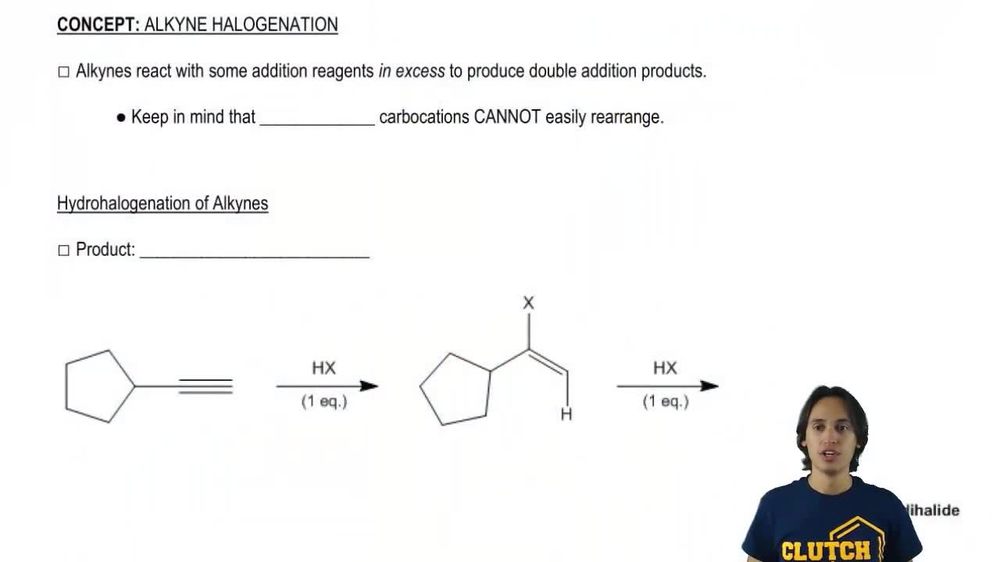
General properties of double addition reactions to alkynes.
Markovnikov's Rule
Markovnikov's Rule states that in the addition of HX to an alkene or alkyne, the hydrogen atom will attach to the carbon with the greater number of hydrogen atoms already attached. This principle is crucial for predicting the major product when converting alkynes to alcohols, as it helps determine the structure of the resulting alcohol based on the regioselectivity of the reaction.
Alcohols are classified based on the number of carbon atoms bonded to the carbon bearing the hydroxyl (-OH) group. Primary alcohols have one carbon, secondary alcohols have two, and tertiary alcohols have three. Understanding this classification is essential for predicting the properties and reactivity of the alcohols formed from the reaction of 3-methyl-1-butyne, including the identification of the second alcohol produced.

 8:03 minutes
 Verified step by step guidance
 01:01
01:01