Draw the structure for each of the following: a. 2,2-dimethyl-4-isopropyloctane
Verified step by step guidance
1
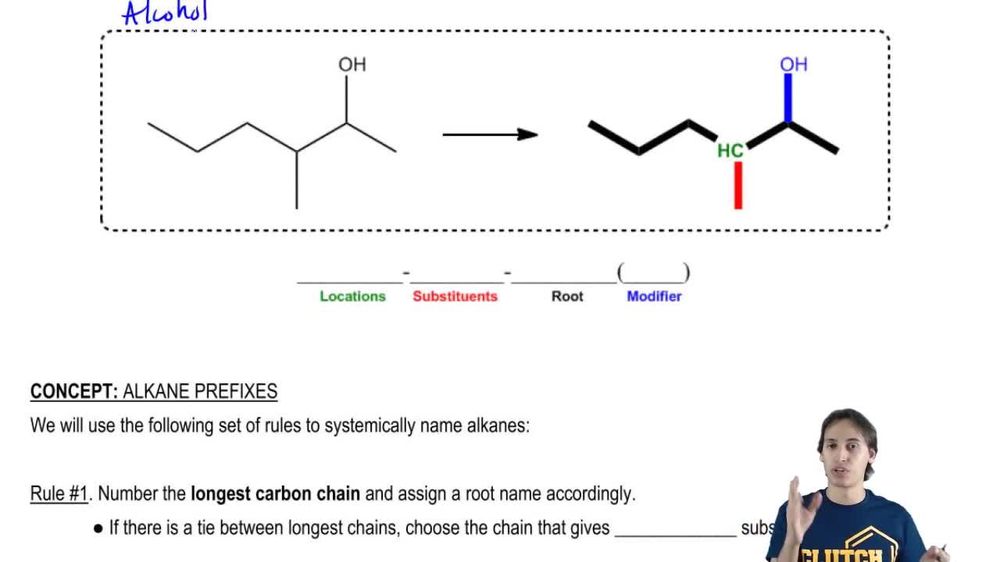
Step 1: Start by identifying the parent chain. The name 'octane' indicates that the parent chain is an 8-carbon straight chain alkane (C8H18). Draw a straight chain of 8 carbons.
Step 2: Number the carbon atoms in the parent chain from left to right. This ensures that substituents are assigned the lowest possible numbers.
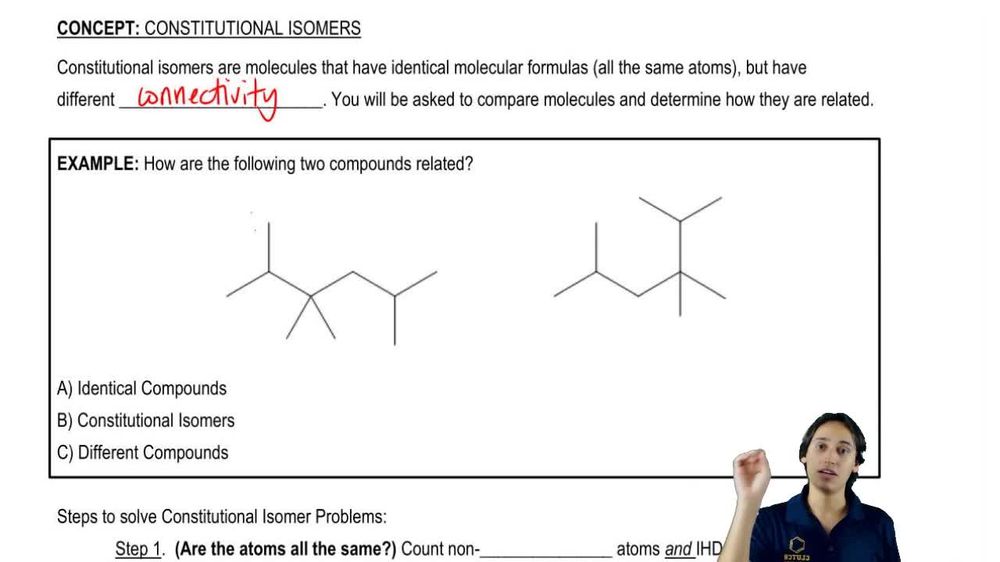
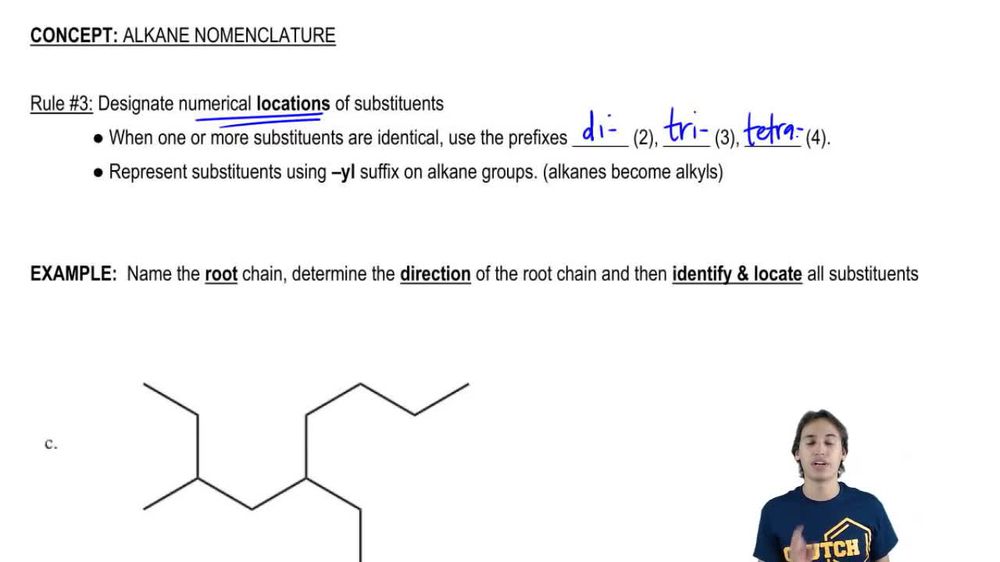
Step 3: Place the substituents on the parent chain. The '2,2-dimethyl' indicates that two methyl groups (-CH3) are attached to carbon 2. Add these groups to the structure.
Step 4: Add the '4-isopropyl' substituent. An isopropyl group is a branched alkyl group with the structure -CH(CH3)2. Attach this group to carbon 4 of the parent chain.
Step 5: Verify the structure by ensuring that all carbons have four bonds and that the substituents are correctly placed according to the IUPAC name. Confirm that the structure matches the name '2,2-dimethyl-4-isopropyloctane.'
Verified video answer for a similar problem:
This video solution was recommended by our tutors as helpful for the problem above
Video duration:
4m
Play a video:
0 Comments
Key Concepts
Here are the essential concepts you must grasp in order to answer the question correctly.
IUPAC Nomenclature
IUPAC nomenclature is a systematic method for naming organic chemical compounds. It provides rules for identifying the structure of a compound based on its name, including the longest carbon chain, substituents, and their positions. Understanding these rules is essential for accurately interpreting and drawing chemical structures from names.
Structural isomers are compounds that have the same molecular formula but different arrangements of atoms. In the case of 2,2-dimethyl-4-isopropyloctane, recognizing how the carbon skeleton can be arranged differently is crucial for drawing the correct structure. This concept highlights the diversity of organic compounds and the importance of spatial arrangement in determining their properties.
Substituents are atoms or groups of atoms that replace hydrogen atoms in a hydrocarbon chain. In 2,2-dimethyl-4-isopropyloctane, the 'dimethyl' and 'isopropyl' groups indicate specific branching points on the main carbon chain. Understanding how to identify and place these substituents is key to accurately constructing the molecular structure.

 4:44 minutes
 Verified step by step guidance
 03:43
03:43