Which of the following structures represent the same compound? Which ones represent different compounds? (c)
Verified step by step guidance
1
Step 1: Analyze the structures provided in the image. Each structure represents a cyclopentane ring with substituents attached. Pay attention to the positions of the substituents (CH₃ and H) and their stereochemistry (wedge and dash bonds indicating 3D orientation).
Step 2: Compare the substituent positions and stereochemistry of each structure. Two compounds are identical if their substituents are in the same positions and have the same stereochemical configuration. If the substituents differ in position or stereochemistry, they represent different compounds.
Step 3: For the first structure, note the positions of the two CH₃ groups and their stereochemistry (one is on a wedge bond and the other on a dash bond). Compare this with the second structure to determine if they are identical or different.
Step 4: Examine the third structure. It has two CH₃ groups attached to the cyclopentane ring, but their positions and stereochemistry differ from the first two structures. Determine if this structure is identical to any of the others or represents a different compound.
Step 5: Analyze the fourth and fifth structures. Compare their substituent positions and stereochemistry with the previous structures. Determine which ones are identical and which ones are different compounds based on the analysis.
Verified video answer for a similar problem:
This video solution was recommended by our tutors as helpful for the problem above
Video duration:
5m
Play a video:
0 Comments
Key Concepts
Here are the essential concepts you must grasp in order to answer the question correctly.
Isomerism
Isomerism refers to the phenomenon where two or more compounds have the same molecular formula but different structural arrangements or spatial orientations. This can lead to different physical and chemical properties. In organic chemistry, isomers can be classified into structural isomers, which differ in the connectivity of atoms, and stereoisomers, which differ in the spatial arrangement of atoms.
Cis-trans isomerism is a type of stereoisomerism that occurs in compounds with restricted rotation around a double bond or within a ring structure. In cis isomers, substituents are on the same side of the double bond or ring, while in trans isomers, they are on opposite sides. This difference in arrangement can significantly affect the physical properties and reactivity of the compounds.
Cycloalkanes are a class of hydrocarbons that contain carbon atoms arranged in a ring structure. They can exhibit isomerism due to the different ways in which substituents can be arranged around the ring. Understanding the structure of cycloalkanes is crucial for identifying whether different representations correspond to the same compound or different ones, particularly in the context of cis-trans isomerism.

 5:56 minutes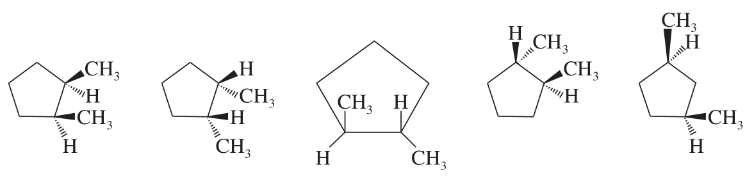
 Verified step by step guidance
 06:47
06:47