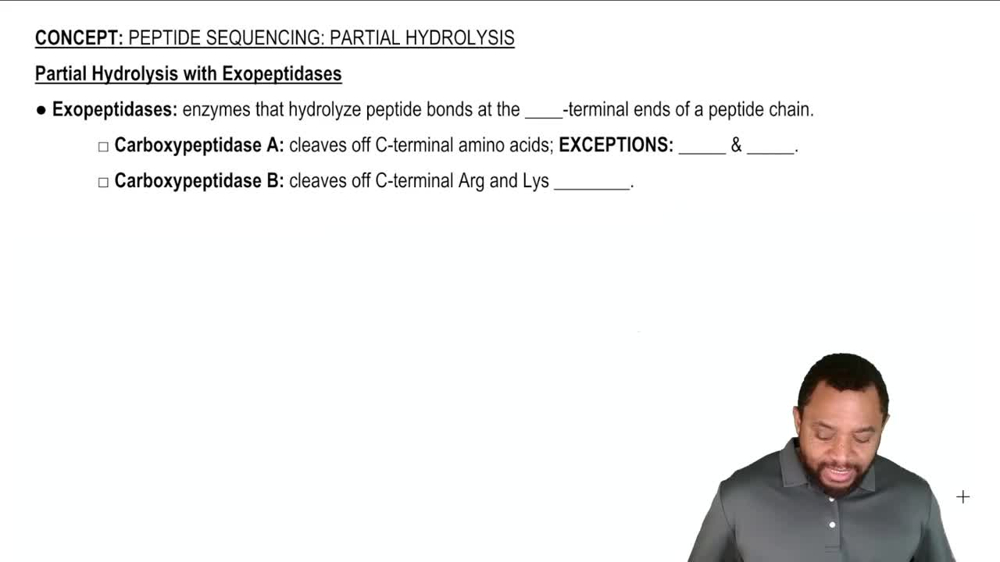
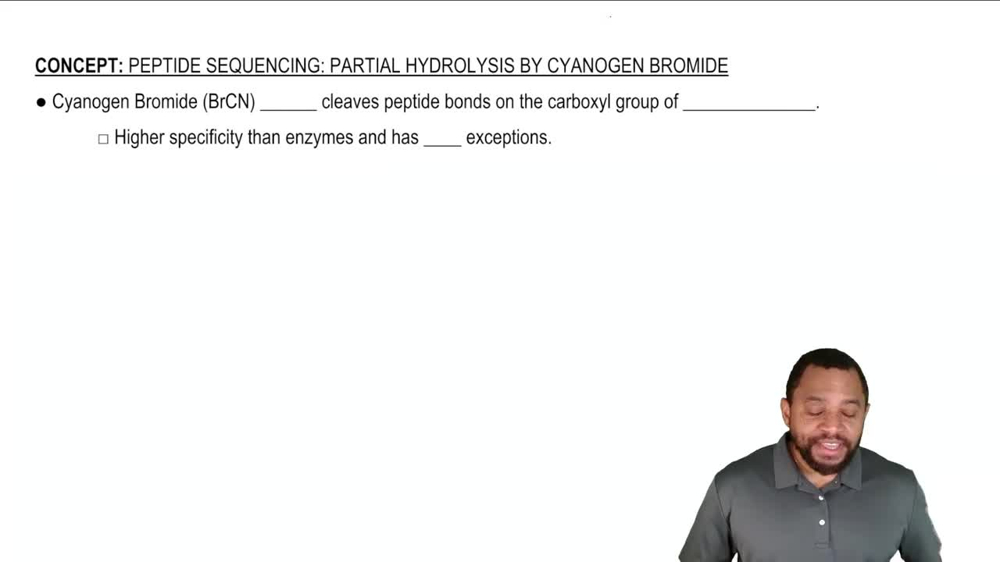
Show the peptides that would result from cleavage by the indicated reagent: a. Val-Arg-Gly-Met-Arg-Ala-Ser by carboxypeptidase A b. Ser-Phe-Lys-Met-Pro-Ser-Ala-Asp by cyanogen bromide c. Arg-Ser-Pro-Lys-Lys-Ser-Glu-Gly by trypsin
Verified step by step guidance
1
Step 1: Understand the cleavage specificity of each reagent. Carboxypeptidase A cleaves amino acids from the C-terminal end, except for Pro, Arg, and Lys. Cyanogen bromide cleaves at the C-terminal side of methionine residues. Trypsin cleaves at the C-terminal side of arginine (Arg) and lysine (Lys) residues, unless followed by proline (Pro).
Step 2: For part (a), Val-Arg-Gly-Met-Arg-Ala-Ser by carboxypeptidase A, sequentially remove amino acids from the C-terminal end, stopping when encountering Arg (since carboxypeptidase A does not cleave after Arg). Write down the resulting peptides after each cleavage step.
Step 3: For part (b), Ser-Phe-Lys-Met-Pro-Ser-Ala-Asp by cyanogen bromide, locate the methionine (Met) residue in the sequence. Cleave at the C-terminal side of Met, resulting in two peptides. Write down the resulting peptide fragments.
Step 4: For part (c), Arg-Ser-Pro-Lys-Lys-Ser-Glu-Gly by trypsin, locate the arginine (Arg) and lysine (Lys) residues in the sequence. Cleave at the C-terminal side of these residues, unless followed by proline (Pro). Write down the resulting peptide fragments.
Step 5: Verify the cleavage products for each part by ensuring the rules of the specific reagent are followed and that the sequence is correctly divided into peptides. Double-check for any exceptions or special cases (e.g., Pro inhibiting cleavage by trypsin).
Verified video answer for a similar problem:
This video solution was recommended by our tutors as helpful for the problem above
Video duration:
5m
Play a video:
0 Comments
Key Concepts
Here are the essential concepts you must grasp in order to answer the question correctly.
Peptide Cleavage
Peptide cleavage refers to the process of breaking peptide bonds between amino acids in a protein or peptide chain. This can be achieved through various enzymes or reagents, each with specific cleavage sites. Understanding the mechanism of cleavage is essential for predicting the resulting peptide fragments.
Carboxypeptidase A is an enzyme that catalyzes the hydrolysis of peptide bonds at the carboxy-terminal end of proteins and peptides. It preferentially cleaves off aromatic and aliphatic amino acids, which is crucial for determining the specific fragments produced from a peptide sequence when this enzyme is applied.
Cyanogen bromide is a chemical reagent that cleaves peptide bonds specifically at the carboxyl side of methionine residues, while trypsin is a proteolytic enzyme that cleaves at the carboxyl side of lysine and arginine residues. Knowledge of these specificities is vital for predicting the products of peptide cleavage in biochemical analysis.

 5:54 minutes
 Verified step by step guidance
 1:24
1:24