Step 1: Understand the structure of 1,3-dichloro-2-pentanol. The molecule has a five-carbon chain (pentane backbone) with chlorine atoms attached to carbons 1 and 3, and a hydroxyl (-OH) group attached to carbon 2. Identify the stereocenters in the molecule. In this case, carbons 2 and 3 are stereocenters because they are bonded to four different groups.
Step 2: Recall the concept of stereoisomers. Stereoisomers are molecules that have the same connectivity of atoms but differ in the spatial arrangement of atoms. For a molecule with two stereocenters, the number of stereoisomers can be calculated using the formula 2^n, where n is the number of stereocenters. Here, n = 2, so there are 2^2 = 4 stereoisomers.
Step 3: Assign configurations to the stereocenters using the Cahn-Ingold-Prelog priority rules. For each stereocenter (carbon 2 and carbon 3), determine the R (rectus) or S (sinister) configuration based on the priority of the groups attached to the stereocenter. This will help distinguish the four stereoisomers.
Step 4: Name each stereoisomer systematically. Combine the R/S configurations of the stereocenters with the IUPAC name of the compound. For example, one stereoisomer might be named (2R,3R)-1,3-dichloro-2-pentanol, while another might be (2R,3S)-1,3-dichloro-2-pentanol, and so on.
Step 5: Verify the names and structures of the stereoisomers. Ensure that each stereoisomer has a unique spatial arrangement and that the names accurately reflect the configurations of the stereocenters. This step ensures clarity and correctness in identifying the four stereoisomers.
Verified video answer for a similar problem:
This video solution was recommended by our tutors as helpful for the problem above
Video duration:
3m
Play a video:
0 Comments
Key Concepts
Here are the essential concepts you must grasp in order to answer the question correctly.
Stereoisomerism
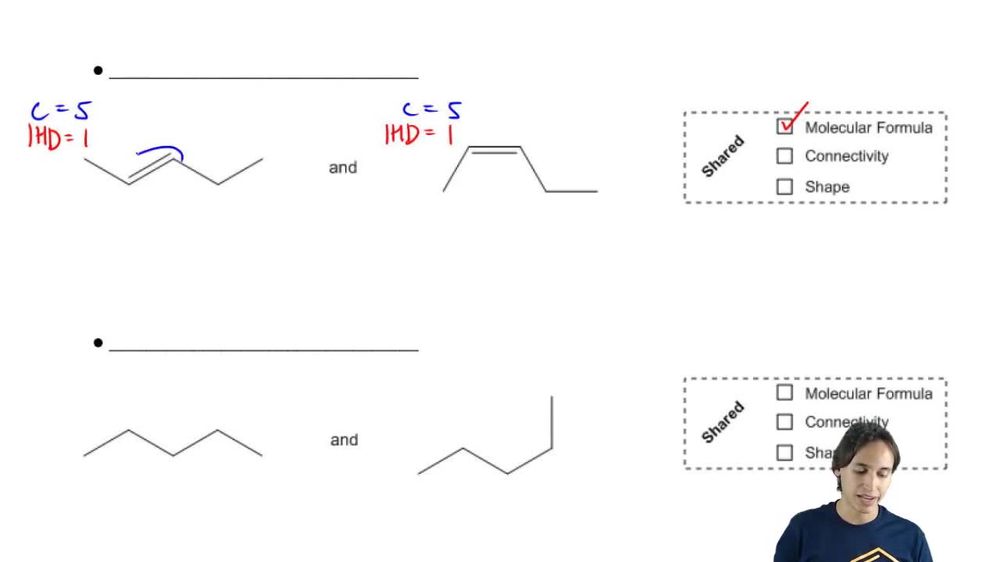
Stereoisomerism refers to the phenomenon where compounds have the same molecular formula and connectivity of atoms but differ in the spatial arrangement of their atoms. This can lead to different physical and chemical properties. In organic chemistry, stereoisomers are classified into two main types: geometric isomers (cis/trans) and optical isomers (enantiomers). Understanding stereoisomerism is crucial for identifying and naming the different forms of a compound.
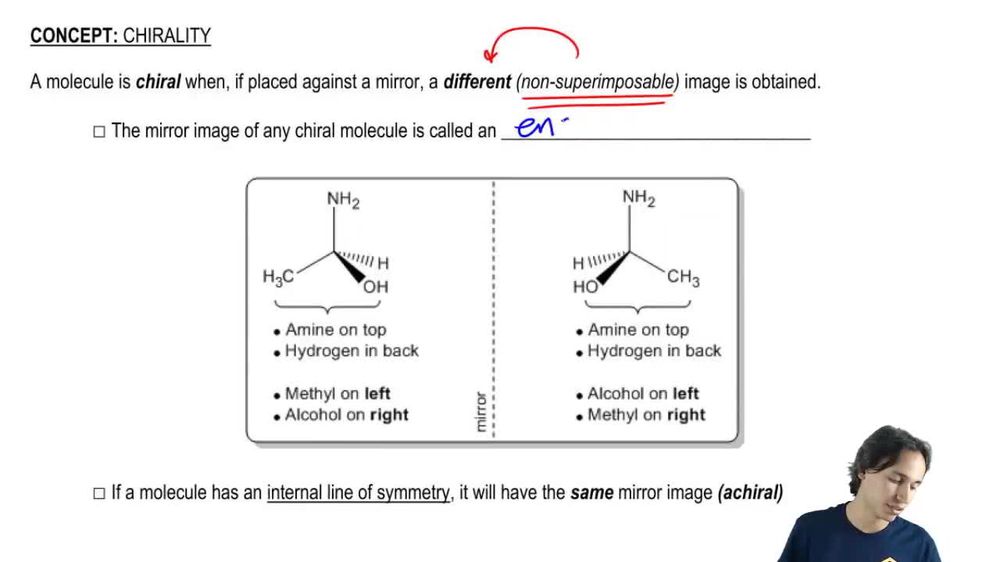
Chirality is a property of a molecule that makes it non-superimposable on its mirror image, much like left and right hands. A chiral center, often a carbon atom, is typically bonded to four different substituents, leading to two distinct enantiomers. In the case of 1,3-dichloro-2-pentanol, the presence of chiral centers is essential for determining the stereoisomers, as each configuration can lead to different isomers.
Configuration refers to the specific arrangement of atoms in a molecule, particularly in relation to chiral centers. The nomenclature of stereoisomers involves designating the configuration using the R/S system for chiral centers and E/Z for geometric isomers. For 1,3-dichloro-2-pentanol, understanding how to assign these configurations is vital for accurately naming and distinguishing the four possible stereoisomers.