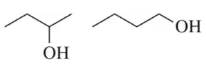
What type of isomerism is indicated by each of the following pairs of molecules? Be as specific as possible. (d)
Verified step by step guidance
1
Step 1: Analyze the molecular structures provided in the image. The first molecule has a hydroxyl (-OH) group attached to the second carbon in a three-carbon chain (isopropanol), while the second molecule has the hydroxyl group attached to the first carbon in a three-carbon chain (1-propanol).
Step 2: Recognize that both molecules have the same molecular formula, C3H8O, indicating they are isomers.
Step 3: Determine the type of isomerism. Since the difference lies in the position of the functional group (-OH) on the carbon chain, this is an example of positional isomerism.
Step 4: Positional isomerism occurs when the functional group is attached to different positions on the same carbon skeleton, while maintaining the same molecular formula.
Step 5: Conclude that the pair of molecules in the image exhibit positional isomerism due to the differing locations of the hydroxyl group on the carbon chain.
Verified video answer for a similar problem:
This video solution was recommended by our tutors as helpful for the problem above
Play a video:
0 Comments
Key Concepts
Here are the essential concepts you must grasp in order to answer the question correctly.
Isomerism
Isomerism refers to the phenomenon where two or more compounds have the same molecular formula but differ in the arrangement of atoms. This can lead to distinct physical and chemical properties. Isomers can be classified into structural isomers, which differ in the connectivity of atoms, and stereoisomers, which have the same connectivity but differ in the spatial arrangement of atoms.
Structural isomerism occurs when isomers differ in the connectivity of their atoms. This can include variations such as chain isomerism, where the carbon skeleton differs, and functional group isomerism, where the isomers contain different functional groups. Understanding structural isomerism is crucial for predicting the reactivity and properties of organic compounds.
Stereoisomerism is a type of isomerism where isomers have the same molecular formula and connectivity but differ in the three-dimensional arrangement of atoms. This includes geometric isomerism (cis-trans isomerism) and optical isomerism (enantiomers). Stereoisomers can exhibit different behaviors in biological systems, making this concept essential for understanding molecular interactions.

 Verified step by step guidance
 06:47
06:47