Given the name, draw the structure of the following alkenes. (b) ((Z)-1-cyclohexyl-2-methylhept-2-ene
Verified step by step guidance
1
Step 1: Understand the nomenclature of the compound. The name ((Z)-1-cyclohexyl-2-methylhept-2-ene) provides information about the structure. The 'Z' designation indicates the stereochemistry of the double bond, meaning the higher priority groups on either side of the double bond are on the same side.
Step 2: Break down the name systematically. 'Hept' indicates a seven-carbon chain as the parent structure. '2-ene' specifies that there is a double bond between carbons 2 and 3. '1-cyclohexyl' means a cyclohexyl group is attached to carbon 1 of the main chain. '2-methyl' indicates a methyl group is attached to carbon 2.
Step 3: Begin drawing the structure. Start with the seven-carbon chain (heptane backbone). Place the double bond between carbons 2 and 3. Attach the cyclohexyl group to carbon 1 and the methyl group to carbon 2.
Step 4: Assign the stereochemistry. Since the compound is (Z)-configured, ensure that the higher priority groups (based on Cahn-Ingold-Prelog rules) on either side of the double bond are on the same side. For example, the cyclohexyl group and the methyl group should be on the same side of the double bond.
Step 5: Double-check the structure for accuracy. Verify that the number of carbons matches the name, the substituents are correctly placed, and the stereochemistry is properly represented. Ensure the double bond is clearly shown and the (Z)-configuration is correctly depicted.
Verified video answer for a similar problem:
This video solution was recommended by our tutors as helpful for the problem above
Play a video:
0 Comments
Key Concepts
Here are the essential concepts you must grasp in order to answer the question correctly.
Alkene Structure
Alkenes are hydrocarbons that contain at least one carbon-carbon double bond (C=C). The presence of this double bond affects the geometry and reactivity of the molecule. Understanding the basic structure of alkenes is crucial for drawing their representations, as it dictates the arrangement of atoms and the overall shape of the molecule.
Cis-trans isomerism, also known as geometric isomerism, occurs in alkenes due to the restricted rotation around the double bond. In the case of (Z)-isomers, the highest priority substituents on each carbon of the double bond are on the same side, leading to specific spatial arrangements. Recognizing this is essential for accurately depicting the structure of the alkene in question.
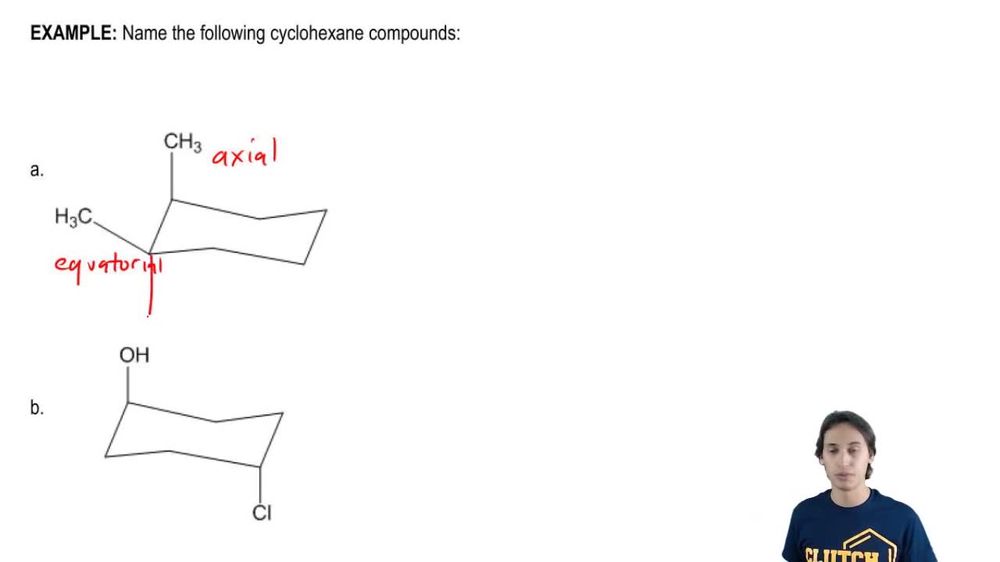
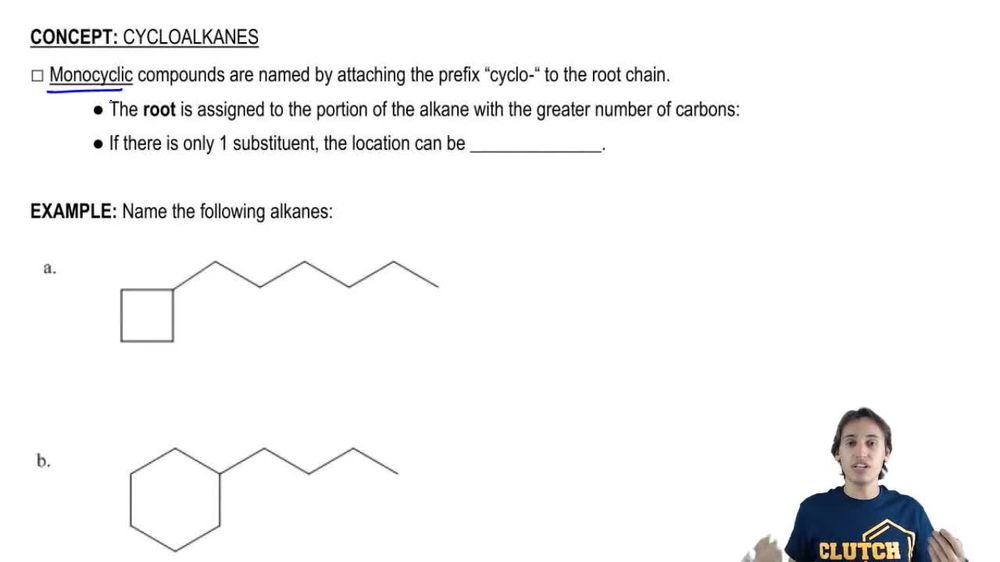
Cycloalkanes are cyclic hydrocarbons that can have substituents attached to their ring structure. In the name (Z)-1-cyclohexyl-2-methylhept-2-ene, 'cyclohexyl' indicates a cyclohexane ring is attached to the first carbon of the heptene chain. Understanding how to identify and position these substituents is key to accurately drawing the molecular structure.

 Verified step by step guidance
 1:59
1:59