What products would be obtained from the reaction of 1,3,5-hexatriene with one equivalent of HBr? Disregard stereoisomers.
Verified step by step guidance
1
Identify the type of reaction: The reaction involves the addition of HBr to 1,3,5-hexatriene, which is a conjugated diene system. This is an electrophilic addition reaction.
Determine the mechanism: The reaction proceeds via the Markovnikov addition mechanism, where the proton (H⁺) from HBr adds to the carbon in the conjugated system that will generate the most stable carbocation intermediate.
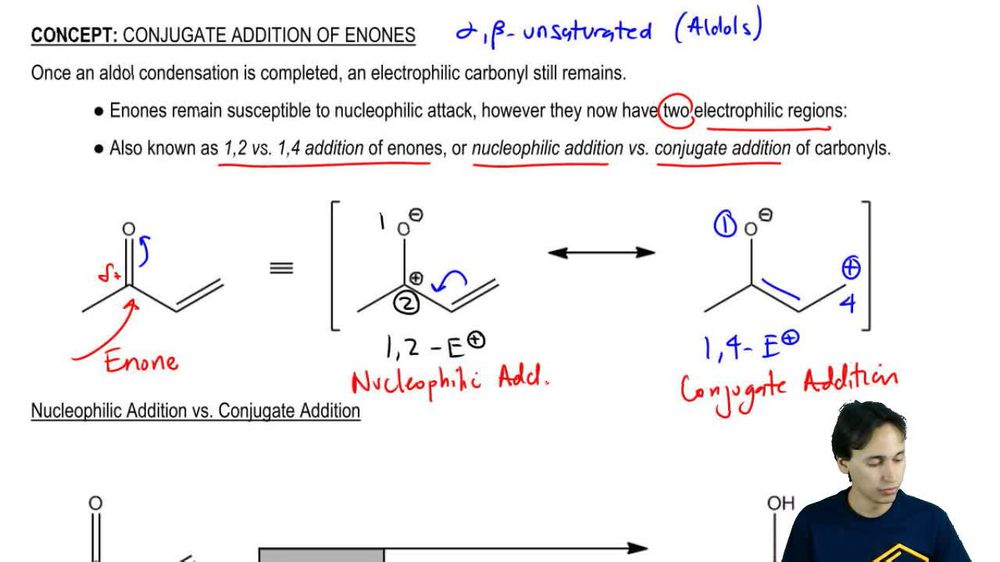
Analyze the conjugated system: 1,3,5-hexatriene has alternating double and single bonds. When H⁺ adds to one of the terminal carbons of the conjugated system, it creates a carbocation that can delocalize over the conjugated π-system, forming resonance-stabilized intermediates.
Add the bromide ion (Br⁻): After the carbocation is formed, the bromide ion (Br⁻) will attack the positively charged carbon in the most stable resonance structure, leading to the formation of the final product.
Determine the product: The product will be a bromoalkene where the bromine atom is attached to the carbon that was part of the most stable carbocation intermediate. Disregard stereoisomers as instructed.
Verified video answer for a similar problem:
This video solution was recommended by our tutors as helpful for the problem above
Video duration:
2m
Play a video:
0 Comments
Key Concepts
Here are the essential concepts you must grasp in order to answer the question correctly.
Electrophilic Addition
Electrophilic addition is a fundamental reaction mechanism in organic chemistry where an electrophile reacts with a nucleophile, typically involving alkenes or alkynes. In the case of 1,3,5-hexatriene, the double bonds act as nucleophiles, attacking the electrophilic hydrogen in HBr, leading to the formation of a more stable carbocation intermediate.
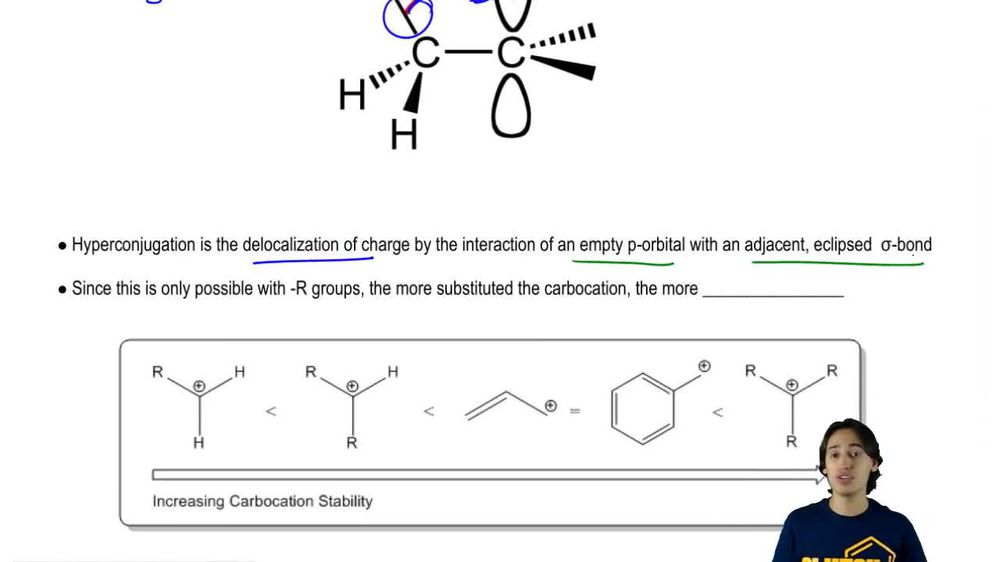
Carbocation stability is crucial in determining the outcome of reactions involving electrophilic addition. Carbocations are positively charged species, and their stability increases with the degree of substitution; tertiary carbocations are more stable than secondary or primary. In the reaction of 1,3,5-hexatriene with HBr, the formation of the most stable carbocation will influence the final product distribution.
Markovnikov's Rule states that in the addition of HX to an alkene, the hydrogen atom will attach to the carbon with the greater number of hydrogen atoms already attached. This rule helps predict the major product of the reaction between 1,3,5-hexatriene and HBr, guiding the formation of the more stable product based on the carbocation formed during the reaction.

 2:26 minutes
 Verified step by step guidance
 09:23
09:23