Propose mechanisms to account for the observed products in the following reactions. (a)
Verified step by step guidance
1
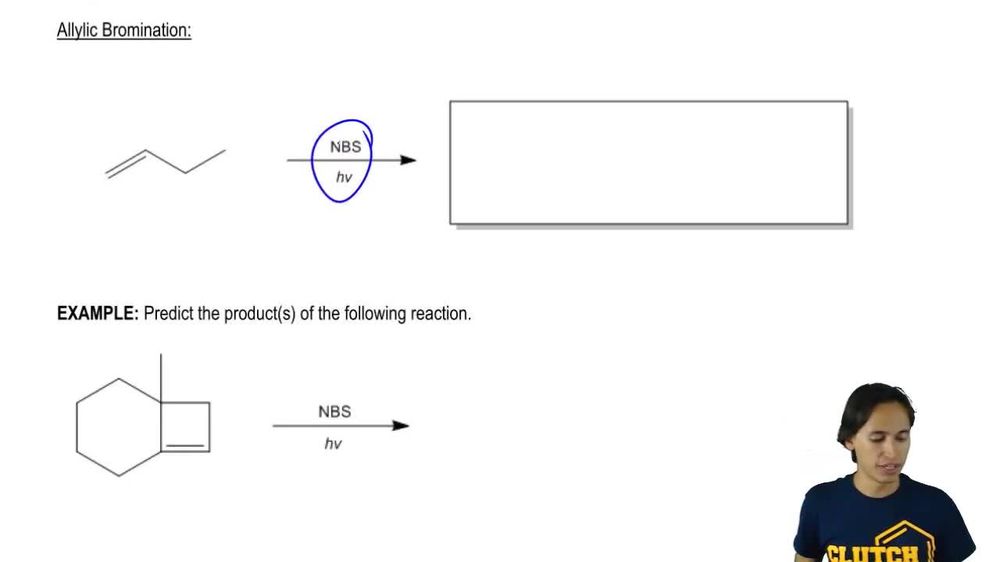
Step 1: Recognize that the reaction involves allylic bromination using NBS (N-bromosuccinimide) under photochemical conditions (hv). NBS selectively brominates allylic positions in the presence of light or heat.
Step 2: Identify the allylic positions in the starting compound (bicyclic alkene). Allylic positions are the carbons adjacent to the double bond, which are stabilized by resonance.
Step 3: Initiate the mechanism with the generation of a bromine radical (Br•) from NBS under photochemical conditions. This radical is responsible for abstracting a hydrogen atom from the allylic position of the substrate.
Step 4: After the hydrogen abstraction, a resonance-stabilized allylic radical is formed. Draw the resonance structures to show the delocalization of the unpaired electron across the π-system of the double bond.
Step 5: The bromine radical then reacts with the allylic radical to form the brominated products. The two observed products arise from the different resonance structures of the allylic radical, leading to bromination at two distinct allylic positions.
Verified video answer for a similar problem:
This video solution was recommended by our tutors as helpful for the problem above
Video duration:
6m
Play a video:
0 Comments
Key Concepts
Here are the essential concepts you must grasp in order to answer the question correctly.
Allylic Bromination
Allylic bromination is a reaction where bromine is added to the allylic position of an alkene, typically using reagents like N-bromosuccinimide (NBS) in the presence of light. This process involves the formation of a radical intermediate, allowing for the selective substitution of hydrogen atoms at the allylic position, leading to the formation of multiple products due to the possibility of bromination at different sites.
The radical mechanism is a reaction pathway that involves the formation and reaction of free radicals, which are highly reactive species with unpaired electrons. In the context of allylic bromination, the mechanism typically proceeds through three steps: initiation (formation of radicals), propagation (reaction of radicals with the substrate), and termination (recombination of radicals). Understanding this mechanism is crucial for predicting the products formed in the reaction.
Regioselectivity refers to the preference of a chemical reaction to yield one structural isomer over others when multiple possibilities exist. In allylic bromination, regioselectivity is influenced by the stability of the radical intermediates formed during the reaction. More stable radicals, such as those that are tertiary or resonance-stabilized, are favored, leading to specific products that can be predicted based on the structure of the starting material.

 6:34 minutes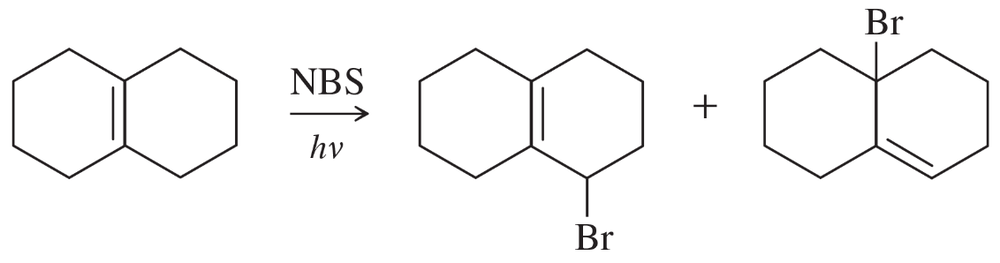
 Verified step by step guidance
 00:54
00:54