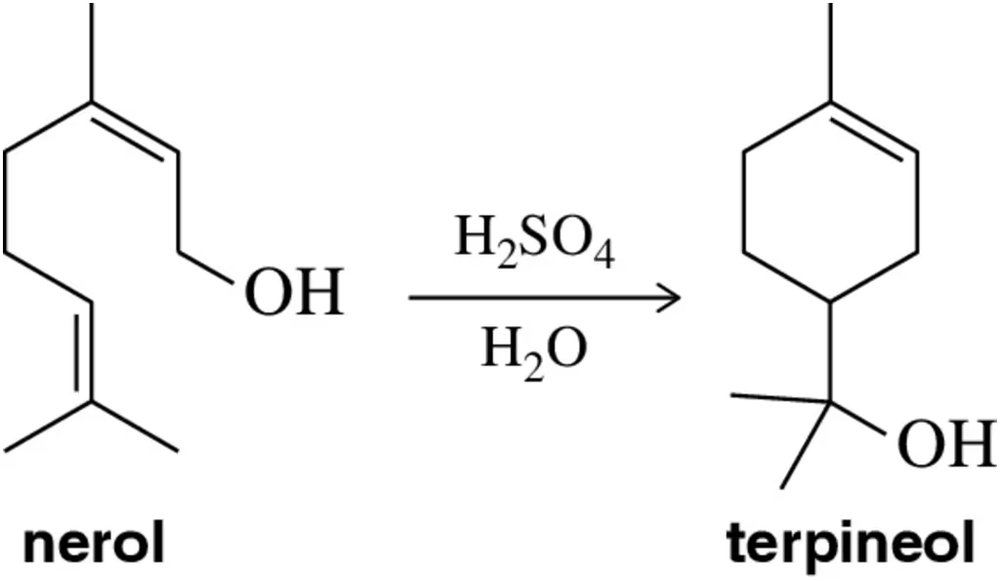
In Chapter 8, we learned about the chemistry of terpenes and the interesting reactions they can undergo. One such reaction is the acid-catalyzed conversion of nerol to terpineol. Suggest a mechanism for this transformation .
Verified step by step guidance
1
Step 1: Recognize that this is an acid-catalyzed reaction. The first step in such reactions typically involves protonation. Protonate the hydroxyl group (-OH) of nerol using the acid catalyst (H⁺), forming a good leaving group (water).
Step 2: After protonation, the water molecule leaves, generating a carbocation intermediate. Identify the location of the carbocation on the nerol structure, ensuring it is consistent with the stability of the intermediate.
Step 3: Consider carbocation rearrangement. If a more stable carbocation can be formed (e.g., through hydride or alkyl shifts), this rearrangement will occur. Analyze the structure of nerol to determine if such a rearrangement is possible.
Step 4: Once the carbocation is stabilized, a nucleophilic attack by water occurs at the carbocation center. This step forms a new bond and introduces a hydroxyl group (-OH) at a different position.
Step 5: Deprotonate the newly added hydroxyl group to regenerate the acid catalyst and form the final product, terpineol. Verify the structure of terpineol to ensure it matches the expected product of the reaction.
Verified video answer for a similar problem:
This video solution was recommended by our tutors as helpful for the problem above
Play a video:
0 Comments
Key Concepts
Here are the essential concepts you must grasp in order to answer the question correctly.
Terpenes
Terpenes are a large and diverse class of organic compounds produced by various plants, particularly conifers. They are characterized by their strong odors and are often used in perfumes and flavorings. Terpenes are built from isoprene units and can undergo various chemical reactions, including rearrangements and functional group transformations, which are essential for understanding their reactivity.
Acid-catalyzed reactions involve the use of an acid to increase the rate of a chemical reaction. In the context of organic chemistry, acids can protonate functional groups, making them more reactive. This mechanism often leads to the formation of carbocations, which are key intermediates in many organic transformations, including the conversion of nerol to terpineol.
A reaction mechanism is a step-by-step description of the process by which reactants are converted into products. It outlines the sequence of elementary steps, including bond breaking and formation, and the intermediates involved. Understanding the mechanism of the acid-catalyzed conversion of nerol to terpineol is crucial for predicting the outcome of the reaction and the stability of intermediates formed during the process.

 .
. Verified step by step guidance
 3:13
3:13