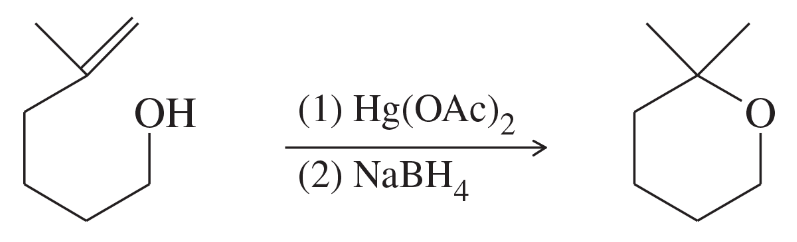
The following cyclization has been observed in the oxymercuration-demercuration of this unsaturated alcohol. Propose a mechanism for this reaction.
Verified step by step guidance
1
Step 1: Analyze the reaction conditions. The reaction involves oxymercuration–demercuration, which typically proceeds via the addition of mercuric acetate (Hg(OAc)₂) to an alkene, followed by reduction with sodium borohydride (NaBH₄). This reaction is known for Markovnikov addition of water across the double bond without carbocation rearrangement.
Step 2: Identify the starting material and product. The starting material is an unsaturated alcohol with a hydroxyl group (-OH) and a double bond. The product is a cyclic ether, indicating that cyclization has occurred during the reaction.
Step 3: Propose the mechanism for oxymercuration. The double bond in the starting material reacts with Hg(OAc)₂ to form a mercurinium ion intermediate. This intermediate is stabilized by the hydroxyl group, which can act as a nucleophile and attack the more substituted carbon of the mercurinium ion, leading to ring closure.
Step 4: Explain the demercuration step. After cyclization, the organomercury intermediate is reduced by NaBH₄, which replaces the mercury group with a hydrogen atom, yielding the final cyclic ether product.
Step 5: Highlight the stereochemical and regiochemical outcomes. The reaction proceeds with Markovnikov regioselectivity, and the hydroxyl group facilitates intramolecular nucleophilic attack, leading to the formation of the cyclic ether. The stereochemistry of the product depends on the specific geometry of the starting material and the reaction pathway.
Verified video answer for a similar problem:
This video solution was recommended by our tutors as helpful for the problem above
Video duration:
8m
Play a video:
0 Comments
Key Concepts
Here are the essential concepts you must grasp in order to answer the question correctly.
Oxymercuration-Demercuration
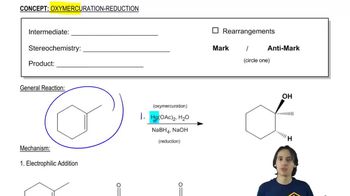
Oxymercuration-demercuration is a two-step reaction used to convert alkenes into alcohols. The first step involves the addition of mercuric acetate (Hg(OAc)2) to the alkene, forming a mercurinium ion intermediate. This intermediate is then attacked by water, leading to the formation of an alcohol. The second step, demercuration, involves the reduction of the mercurial compound to yield the final alcohol product.
Cyclization refers to the process where a linear or branched chain molecule forms a cyclic structure. In the context of the oxymercuration-demercuration reaction, the formation of a cyclic ether or alcohol can occur through intramolecular nucleophilic attack. Understanding the mechanism of cyclization is crucial for predicting the product structure and the stereochemistry of the reaction.
Stereochemistry is the study of the spatial arrangement of atoms in molecules and how this affects their chemical behavior. In reactions involving cyclic compounds, stereochemistry plays a significant role in determining the configuration of the product. It is essential to consider stereochemical outcomes when proposing mechanisms, especially in reactions that involve chiral centers or multiple stereogenic centers.