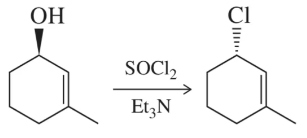
When SOCl2 is used in place of HCl, only one product results. Why are these conditions better?
Verified step by step guidance
1
Identify the starting material and the reagent: The starting material is an alcohol, and the reagent is thionyl chloride (SOCl2) in the presence of a base (Et3N).
Understand the mechanism: SOCl2 converts alcohols to alkyl chlorides through a mechanism that involves the formation of an intermediate chlorosulfite ester, which then undergoes a nucleophilic substitution reaction.
Compare with HCl: When HCl is used, the reaction typically proceeds through an SN1 mechanism, which can lead to carbocation rearrangements and result in multiple products.
Explain the advantage of SOCl2: The use of SOCl2 avoids carbocation formation and rearrangement, leading to a single product through an SN2 mechanism, which is stereospecific and retains the configuration of the starting material.
Conclude why SOCl2 is better: SOCl2 provides a more controlled and predictable reaction pathway, resulting in a single, desired product without side reactions or rearrangements.
Verified video answer for a similar problem:
This video solution was recommended by our tutors as helpful for the problem above
Play a video:
0 Comments
Key Concepts
Here are the essential concepts you must grasp in order to answer the question correctly.
Thionyl Chloride (SOCl₂) Reactivity
Thionyl chloride is a reagent commonly used in organic synthesis for converting alcohols into alkyl chlorides. Its unique reactivity allows for the formation of a single product due to the mechanism involving the formation of a cyclic intermediate, which leads to a more controlled reaction pathway compared to other reagents like HCl.
Nucleophilic substitution is a fundamental reaction in organic chemistry where a nucleophile replaces a leaving group in a molecule. The mechanism can proceed via either an SN1 or SN2 pathway, influencing the number of products formed. SOCl₂ typically favors the SN2 mechanism, resulting in a single product due to its steric and electronic properties.
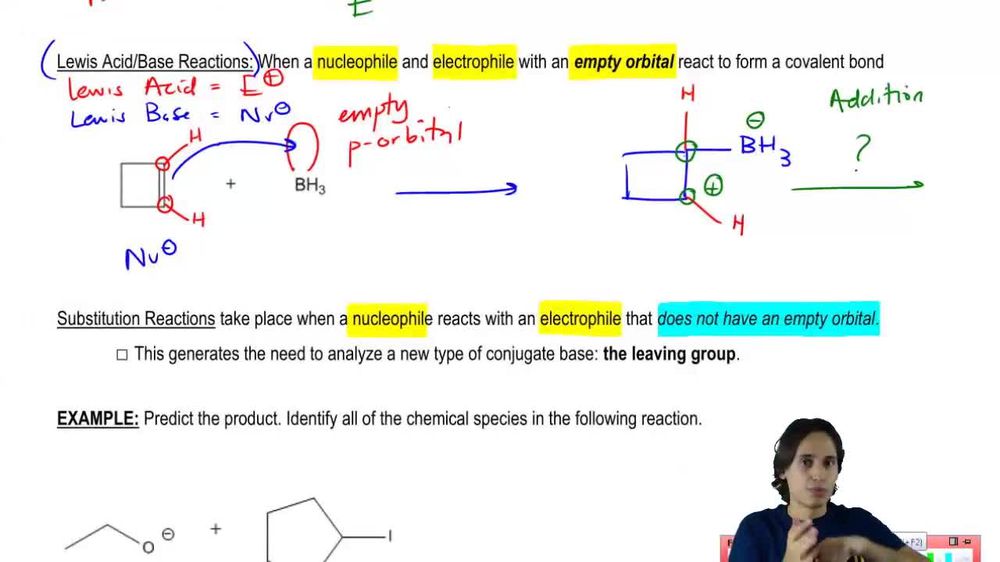
Nucleophiles and Electrophiles can react in Substitution Reactions.
Selectivity in Organic Reactions
Selectivity refers to the ability of a reaction to produce a specific product over others. In the case of SOCl₂, the reaction conditions and the nature of the reagent lead to high selectivity, minimizing side reactions and by-products. This contrasts with HCl, which can lead to multiple products due to its less selective nature in nucleophilic substitution.