
Proof that an imine was formed between aldolase and its substrate was obtained by using D-fructose-1,6-bisphosphate labeled at the C-2 position with 14C as the substrate. NaBH4 was added to the reaction mixture. A radioactive product was isolated from the reaction mixture and hydrolyzed in an acidic solution. Draw the structure of the radioactive product obtained from the acidic solution. (Hint: NaBH4 reduces an imine linkage.)
Verified step by step guidance
1
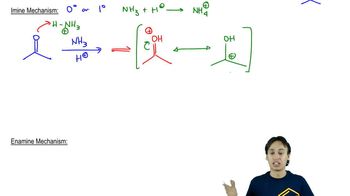
Understand the reaction mechanism: The problem involves the formation of an imine intermediate between aldolase and its substrate, D-fructose-1,6-bisphosphate, labeled with 14C at the C-2 position. Imine formation occurs when a primary amine reacts with a carbonyl group, resulting in a C=N bond.
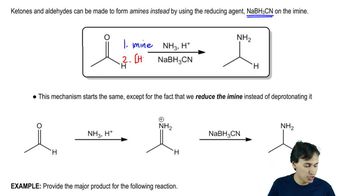
Recognize the role of NaBH4: Sodium borohydride (NaBH4) is a reducing agent that specifically reduces imines (C=N) to amines (C-N). This reduction step is crucial for stabilizing the intermediate and isolating the product.
Predict the radioactive product after NaBH4 reduction: After NaBH4 reduces the imine, the resulting product will have a C-N bond at the position where the imine was formed. The 14C label at the C-2 position will remain intact, as the reduction does not affect the carbon labeling.
Understand the hydrolysis step: The hydrolysis in acidic solution will cleave the bond between the enzyme and the substrate, releasing the reduced substrate as the final product. The structure of the product will include the reduced amine group and the intact D-fructose-1,6-bisphosphate backbone with the 14C label at C-2.
Draw the structure of the final product: The final product will be D-fructose-1,6-bisphosphate with a reduced amine group at the position where the imine was formed. Ensure the 14C label is clearly indicated at the C-2 position in the structure.
Verified video answer for a similar problem:
This video solution was recommended by our tutors as helpful for the problem above
Video duration:
7m
Play a video:
0 Comments
Key Concepts
Here are the essential concepts you must grasp in order to answer the question correctly.
Imine Formation
Imine formation occurs when a carbonyl compound, such as an aldehyde or ketone, reacts with an amine, resulting in the creation of a C=N bond. This reaction is typically facilitated by the removal of water, which drives the equilibrium towards imine formation. Understanding this process is crucial for analyzing the reaction between aldolase and its substrate, as the formation of an imine is a key step in the mechanism.
Sodium borohydride (NaBH4) is a selective reducing agent commonly used in organic chemistry to reduce carbonyl compounds, including imines, to their corresponding amines. In the context of the question, NaBH4 reduces the imine linkage formed between aldolase and the substrate, leading to the formation of a stable amine product. This reduction is essential for understanding the transformation of the imine into a detectable product.
Radioactive labeling involves incorporating a radioactive isotope, such as 14C, into a molecule to trace its path through a chemical reaction. In this case, d-fructose-1,6-bisphosphate is labeled at the C-2 position, allowing researchers to track the formation of the radioactive product. This technique is vital for confirming the structure of the product and understanding the reaction mechanism, as it provides a means to identify and isolate specific compounds.