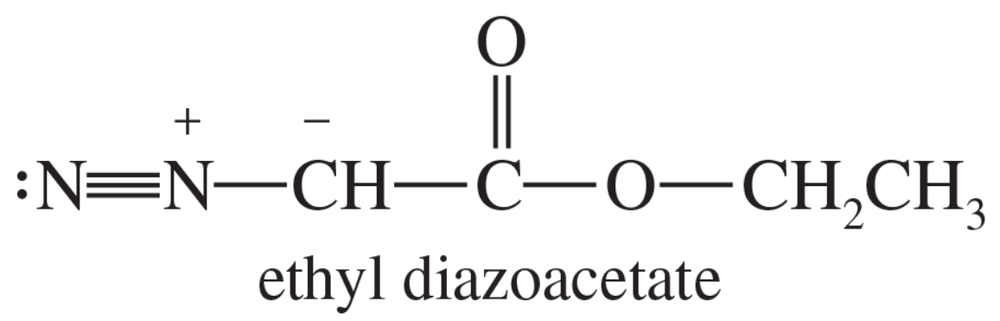
When it is strongly heated, ethyl diazoacetate decomposes to give nitrogen gas and a carbene. Draw a Lewis structure of the carbene.
Verified step by step guidance
1
Identify the structure of ethyl diazoacetate from the image. It consists of a diazo group (N2) attached to a carbon, which is also connected to an ester group.
Understand that upon heating, ethyl diazoacetate decomposes to release nitrogen gas (N2), leaving behind a carbene. The diazo group is responsible for this decomposition.
Focus on the carbon atom that is directly attached to the diazo group. This carbon will become the carbene after the nitrogen gas is released.
Draw the Lewis structure of the carbene. A carbene is a neutral species with a divalent carbon atom that has two non-bonded electrons. Represent the carbon with two single bonds and a pair of dots indicating the lone pair of electrons.
Ensure that the carbene carbon is shown with only six electrons in its valence shell, reflecting its divalent nature. This includes the two electrons from the lone pair and the electrons from the two single bonds.
Verified video answer for a similar problem:
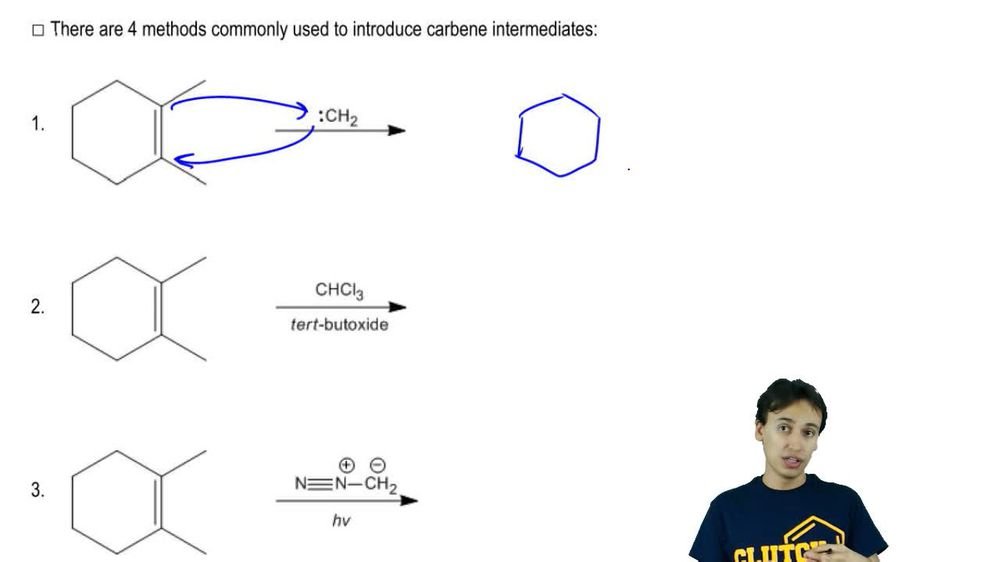
This video solution was recommended by our tutors as helpful for the problem above
Video duration:
4m
Play a video:
0 Comments
Key Concepts
Here are the essential concepts you must grasp in order to answer the question correctly.
Carbene
A carbene is a reactive intermediate in organic chemistry characterized by a carbon atom with only six valence electrons, resulting in a divalent state. This species typically has a neutral charge and can exist in two forms: singlet (with paired electrons) and triplet (with unpaired electrons). Carbenes are highly reactive and can participate in various chemical reactions, including insertion into C-H bonds and cyclopropanation.
A decomposition reaction is a type of chemical reaction where a single compound breaks down into two or more simpler products. In the case of ethyl diazoacetate, heating causes it to decompose into nitrogen gas and a carbene. This process is often endothermic and can be driven by heat, light, or other forms of energy, leading to the formation of reactive intermediates.
Lewis structures are diagrams that represent the bonding between atoms in a molecule and the lone pairs of electrons that may exist. They are essential for visualizing the arrangement of electrons and understanding molecular geometry. In drawing a Lewis structure for a carbene, it is crucial to depict the carbon atom with a double bond to another atom and two unshared electrons, illustrating its unique electronic configuration.