Given the value of Keq for the following acid–base reactions, identify the weakest acid and the weakest base. (a)
Verified step by step guidance
1
Step 1: Understand the relationship between the equilibrium constant (K_eq) and acid/base strength. A larger K_eq indicates that the reaction favors the products, meaning the acid on the reactant side is stronger than the acid on the product side. Similarly, the base on the reactant side is stronger than the base on the product side.
Step 2: Write the general acid-base reaction: HA (acid) + B⁻ (base) ⇌ A⁻ (conjugate base) + HB (conjugate acid). Identify the acids and bases on both sides of the reaction.
Step 3: Use the value of K_eq to determine the relative strengths of the acids and bases. If K_eq > 1, the acid on the reactant side (HA) is stronger than the conjugate acid (HB) on the product side. If K_eq < 1, the conjugate acid (HB) is stronger than the acid (HA).
Step 4: Identify the weakest acid by comparing the acids on both sides of the reaction. The weaker acid will be the one that is less likely to donate a proton (lower tendency to ionize).
Step 5: Identify the weakest base by comparing the bases on both sides of the reaction. The weaker base will be the one that is less likely to accept a proton (lower tendency to react with H⁺).
Verified video answer for a similar problem:
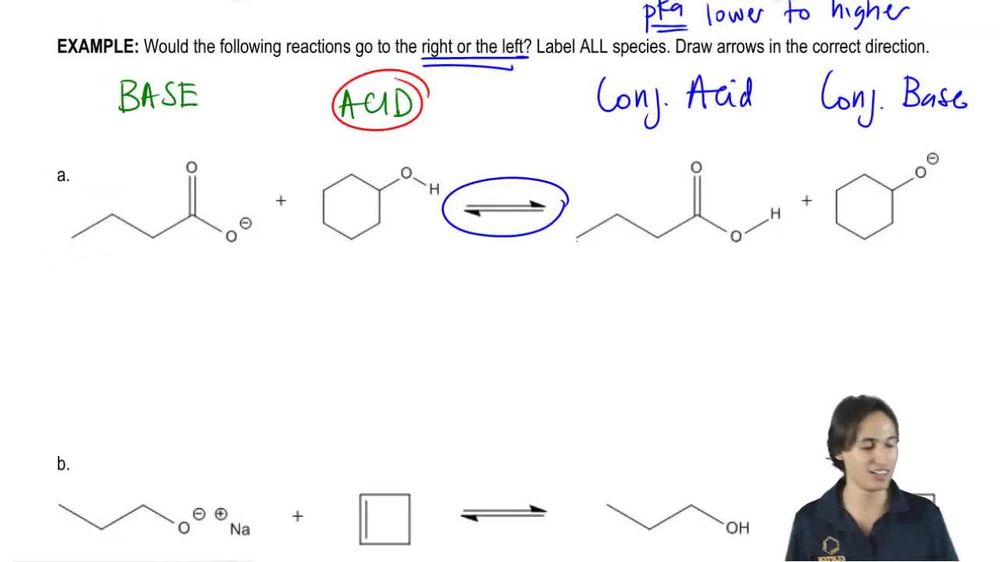
This video solution was recommended by our tutors as helpful for the problem above
Video duration:
3m
Play a video:
0 Comments
Key Concepts
Here are the essential concepts you must grasp in order to answer the question correctly.
Acid-Base Equilibrium
Acid-base equilibrium refers to the state where the rates of the forward and reverse reactions of an acid dissociating into its conjugate base and a proton are equal. The equilibrium constant (K_eq) quantifies the ratio of the concentrations of products to reactants at equilibrium. A higher K_eq value indicates a stronger acid, as it favors the formation of products, while a lower K_eq suggests a weaker acid.
The strength of an acid or base is determined by its ability to donate protons (H+) or accept protons, respectively. Strong acids completely dissociate in solution, while weak acids only partially dissociate. Similarly, strong bases fully accept protons, whereas weak bases do so to a lesser extent. Understanding the relative strengths helps in identifying the weakest acid and base in a given reaction.
Conjugate acid-base pairs consist of an acid and its corresponding base formed after the acid donates a proton. The strength of an acid is inversely related to the strength of its conjugate base; a strong acid has a weak conjugate base and vice versa. Analyzing these pairs in the context of K_eq values allows for the identification of the weakest acid and base in a reaction.