Neopentyl alcohol, (CH3)3CCH2OH, reacts with concentrated HBr to give 2-bromo-2-methylbutane, a rearranged product. Propose a mechanism for the formation of this product.
Verified step by step guidance
1
Step 1: Protonation of the hydroxyl group - The reaction begins with the protonation of the hydroxyl group (-OH) in neopentyl alcohol by the concentrated HBr. This forms a good leaving group, water (H2O), and converts the alcohol into a protonated intermediate.
Step 2: Formation of a carbocation - The protonated intermediate undergoes loss of water, resulting in the formation of a primary carbocation at the carbon attached to the hydroxyl group. However, primary carbocations are unstable.
Step 3: Carbocation rearrangement - To achieve greater stability, the primary carbocation undergoes a hydride shift (a hydrogen atom with its bonding electrons moves) from the adjacent tertiary carbon. This rearrangement forms a more stable tertiary carbocation at the central carbon atom.
Step 4: Nucleophilic attack by bromide ion - The bromide ion (Br⁻), which is generated from the dissociation of HBr, acts as a nucleophile and attacks the positively charged tertiary carbocation. This results in the formation of 2-bromo-2-methylbutane.
Step 5: Final product - The final product of the reaction is 2-bromo-2-methylbutane, which is the rearranged product formed through the mechanism involving carbocation rearrangement and nucleophilic substitution.
Verified video answer for a similar problem:
This video solution was recommended by our tutors as helpful for the problem above
Video duration:
5m
Play a video:
0 Comments
Key Concepts
Here are the essential concepts you must grasp in order to answer the question correctly.
Rearrangement in Organic Reactions
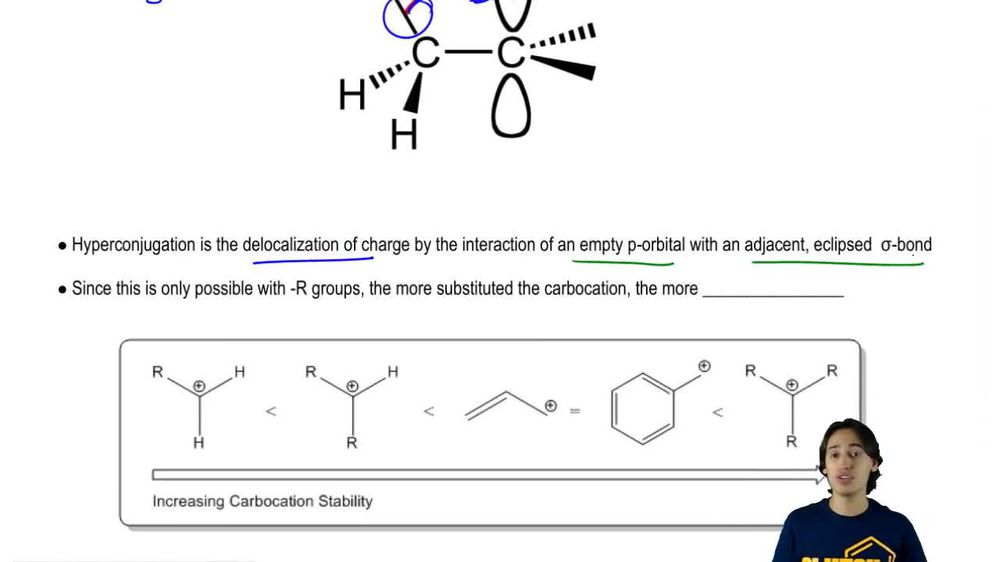
Rearrangement refers to the process where the structure of a molecule changes during a chemical reaction, often leading to more stable products. In the case of neopentyl alcohol reacting with HBr, the initial carbocation formed can undergo a hydride shift, resulting in a more stable tertiary carbocation that ultimately leads to the formation of 2-bromo-2-methylbutane.
Carbocations are positively charged carbon species that play a crucial role in many organic reactions. Their stability is influenced by the degree of substitution: tertiary carbocations are more stable than secondary or primary ones due to hyperconjugation and inductive effects. In this reaction, the formation of a tertiary carbocation from neopentyl alcohol is favored, leading to the rearranged product.
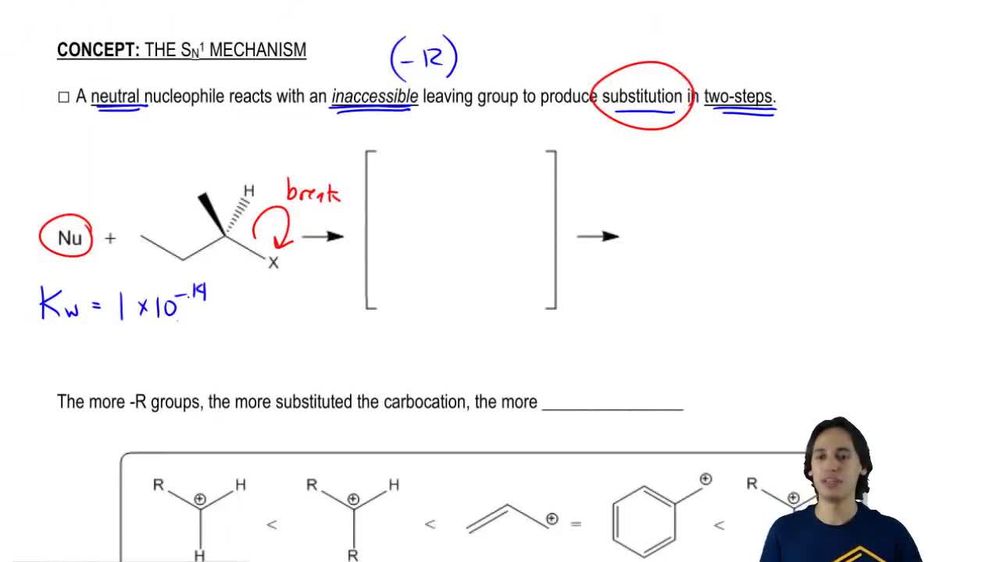
The SN1 mechanism is a two-step nucleophilic substitution process where the first step involves the formation of a carbocation intermediate after the leaving group departs. The second step involves the nucleophile attacking the carbocation. In the case of neopentyl alcohol and HBr, the reaction proceeds via an SN1 mechanism, where the alcohol first loses a water molecule to form a carbocation, which then reacts with bromide to form the final product.

 5:13 minutes
 Verified step by step guidance

 06:08
06:08