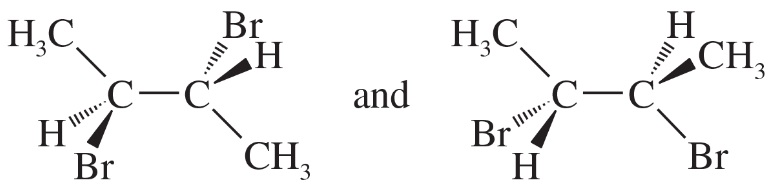
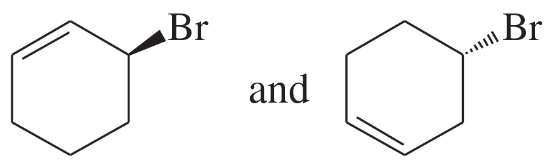
For each pair, give the relationship between the two compounds. Making models will be helpful. (c) (d)
Verified step by step guidance
1
Step 1: Analyze the structures in part (c). Both compounds are 2-bromo-2-methylbutane derivatives. Observe the spatial arrangement of the substituents around the chiral center (carbon bonded to Br, H, CH3, and CH2CH3). Determine if the compounds are mirror images (enantiomers), identical, or diastereomers.
Step 2: For part (c), check the configuration of the chiral centers using the Cahn-Ingold-Prelog priority rules. Assign R or S configuration to each compound based on the priority of the substituents.
Step 3: Compare the configurations of the two compounds in part (c). If they have opposite configurations (e.g., one is R and the other is S), they are enantiomers. If they have the same configuration, they are identical. If they differ at one chiral center but not the other, they are diastereomers.
Step 4: Analyze the structures in part (d). Both compounds are cyclohexene derivatives with a bromine substituent. Observe the spatial arrangement of the bromine atom (wedge or dash) relative to the double bond. Determine if the compounds are cis-trans isomers or identical.
Step 5: For part (d), check the relative positions of the bromine atom and the double bond. If the bromine is on the same side of the ring as the double bond, the compound is cis. If the bromine is on the opposite side, the compound is trans. Compare the two structures to determine their relationship.
Verified video answer for a similar problem:
This video solution was recommended by our tutors as helpful for the problem above
Video duration:
5m
Play a video:
0 Comments
Key Concepts
Here are the essential concepts you must grasp in order to answer the question correctly.
Stereochemistry
Stereochemistry is the study of the spatial arrangement of atoms in molecules and how this affects their chemical behavior. In organic chemistry, stereoisomers are compounds that have the same molecular formula and connectivity but differ in the orientation of their atoms in space. Understanding stereochemistry is crucial for analyzing the relationships between compounds, especially when dealing with chiral centers and geometric isomers.
Conformational analysis involves studying the different spatial arrangements (conformations) that a molecule can adopt due to rotation around single bonds. In the context of the provided compounds, analyzing their conformations helps to understand the stability and reactivity of each isomer. This concept is essential for predicting how molecules will interact and behave in chemical reactions.
Substituent effects refer to how different atoms or groups attached to a carbon chain influence the properties and reactivity of the molecule. In the given compounds, the presence of bromine atoms affects the steric and electronic environment around the carbon atoms, which can lead to different physical and chemical properties. Recognizing these effects is vital for predicting the behavior of organic compounds in various reactions.