Give the substitution and elimination products you would expect from the following reactions. b. 1-iodo-1-phenylcyclopentane heated in ethanol
Verified step by step guidance
1
Identify the type of reaction mechanism that can occur. In this case, the substrate (1-iodo-1-phenylcyclopentane) is a secondary alkyl halide, which can undergo both substitution (SN1 or SN2) and elimination (E1 or E2) reactions. The solvent, ethanol, is a polar protic solvent, favoring SN1 and E1 mechanisms.
Analyze the conditions. Heating the reaction mixture typically promotes elimination (E1) over substitution (SN1), as heat provides the energy required for the formation of the carbocation intermediate and subsequent elimination of a proton.
For the SN1 mechanism: The iodine atom leaves first, forming a carbocation intermediate. The phenyl group stabilizes the carbocation through resonance. Ethanol, acting as a nucleophile, can attack the carbocation to form the substitution product, which is an ether.
For the E1 mechanism: After the carbocation is formed, a beta-hydrogen (a hydrogen atom on a carbon adjacent to the carbocation) is removed by ethanol acting as a base. This results in the formation of a double bond, yielding an alkene as the elimination product. The major product will follow Zaitsev's rule, where the more substituted alkene is favored.
Consider stereochemistry and regioselectivity. For the elimination product, the trans (E) isomer is typically more stable and favored over the cis (Z) isomer due to reduced steric hindrance. For the substitution product, the stereochemistry depends on the attack of ethanol on the planar carbocation intermediate.
Verified video answer for a similar problem:
This video solution was recommended by our tutors as helpful for the problem above
Video duration:
4m
Play a video:
0 Comments
Key Concepts
Here are the essential concepts you must grasp in order to answer the question correctly.
Substitution Reactions
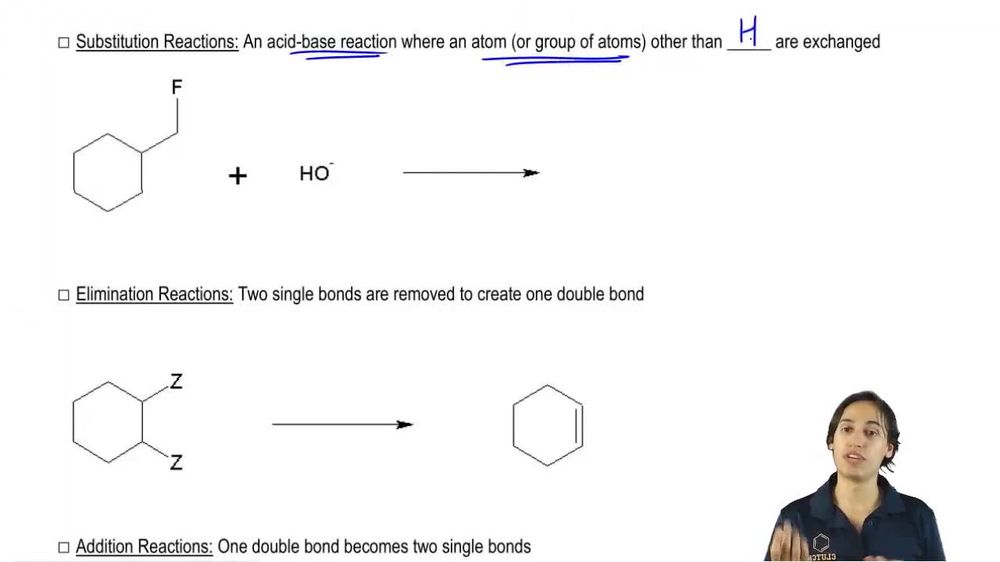
Substitution reactions involve the replacement of one functional group in a molecule with another. In organic chemistry, this often occurs with alkyl halides, where a nucleophile attacks the carbon atom bonded to the halogen, leading to the formation of a new bond and the release of the halide ion. The type of substitution (SN1 or SN2) depends on factors like the structure of the substrate and the nature of the nucleophile.
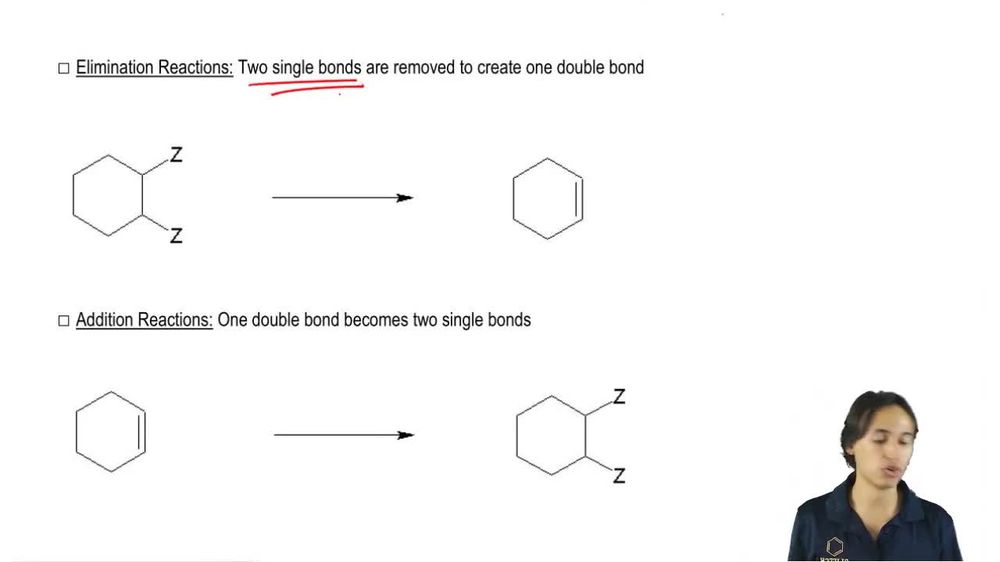
Elimination reactions involve the removal of two atoms or groups from a molecule, resulting in the formation of a double bond or a ring structure. In the context of alkyl halides, elimination can occur via E1 or E2 mechanisms, where a base abstracts a proton, and the leaving group departs simultaneously or sequentially. The conditions, such as heat and solvent, can influence the pathway and products formed.
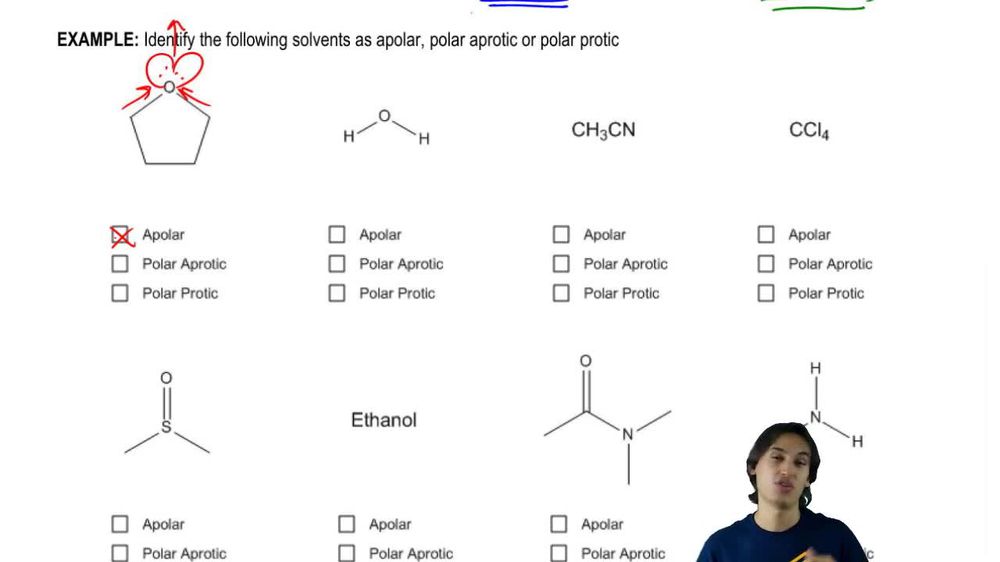
The choice of solvent can significantly influence the outcome of substitution and elimination reactions. Polar protic solvents, like ethanol, can stabilize ions and facilitate SN1 and E1 mechanisms, while polar aprotic solvents favor SN2 and E2 pathways. In the case of heating 1-iodo-1-phenylcyclopentane in ethanol, the solvent's properties will affect whether substitution or elimination products are favored.