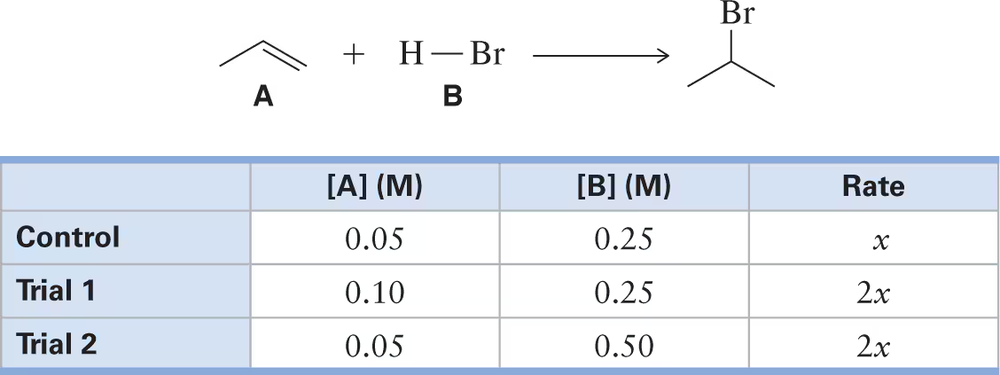
Given the following rate data, how many molecules are in the rate-determining step of this reaction?
Verified step by step guidance
1
Analyze the rate law provided in the problem or deduce it from the given rate data. The rate law is typically expressed as: , where and are the reaction orders with respect to reactants A and B.
Determine the overall reaction order by summing the exponents in the rate law: . This overall order corresponds to the number of molecules involved in the rate-determining step (also called the molecularity of the step).
Compare the molecularity deduced from the rate law to the proposed mechanism in Chapter 8. Identify the step in the mechanism that matches the molecularity and confirm whether it aligns with the rate-determining step.
Verify that the rate-determining step involves the correct reactants and intermediates as indicated by the rate law. For example, if the rate law includes and , ensure that these species are present in the slow step of the mechanism.
Conclude whether the mechanism provided in Chapter 8 is consistent with the rate law and the molecularity of the rate-determining step. If inconsistencies are found, suggest possible adjustments to the mechanism to align with the observed rate law.
Verified video answer for a similar problem:
This video solution was recommended by our tutors as helpful for the problem above
Video duration:
7m
Play a video:
0 Comments
Key Concepts
Here are the essential concepts you must grasp in order to answer the question correctly.
Rate-Determining Step
The rate-determining step (RDS) is the slowest step in a reaction mechanism that determines the overall reaction rate. It acts as a bottleneck, meaning that the speed of the entire reaction cannot exceed the speed of this step. Understanding the RDS is crucial for analyzing reaction kinetics and predicting how changes in conditions can affect the reaction rate.
Molecularity refers to the number of reactant molecules involved in an elementary step of a reaction mechanism. It can be unimolecular (one molecule), bimolecular (two molecules), or termolecular (three molecules). The molecularity of the rate-determining step is essential for determining the rate law and understanding how reactant concentrations influence the reaction rate.
A reaction mechanism is a step-by-step description of the pathway taken by reactants to form products. It includes all elementary steps, intermediates, and the rate-determining step. Understanding the mechanism is vital for correlating experimental rate data with theoretical predictions, allowing chemists to validate or refine their models of how reactions occur.