Show how you would accomplish the following synthetic transformations. Show all intermediates. h. hex-1-yne → hexan-2-one, CH3COCH2CH2CH2CH3
Verified step by step guidance
1
Step 1: Begin with hex-1-yne (CH≡CCH2CH2CH2CH3). The goal is to convert the terminal alkyne into a ketone at the second carbon position. This transformation can be achieved using hydroboration-oxidation or acid-catalyzed hydration.
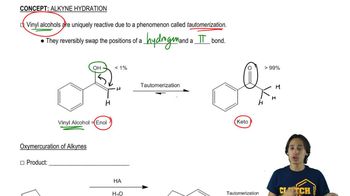
Step 2: Use acid-catalyzed hydration with HgSO4 and H2SO4 in water. This reaction follows Markovnikov's rule, where the OH group adds to the more substituted carbon of the triple bond, forming an enol intermediate.
Step 3: The enol intermediate undergoes tautomerization, a process where the enol rearranges to form a ketone. In this case, the enol (CH3C(OH)=CHCH2CH2CH3) rearranges to hexan-2-one (CH3COCH2CH2CH2CH3).
Step 4: Verify the structure of the product. Hexan-2-one is a ketone with the carbonyl group on the second carbon, consistent with the desired transformation.
Step 5: Ensure all intermediates are accounted for and the reaction conditions are appropriate for the transformation. The use of HgSO4 and H2SO4 ensures the reaction proceeds efficiently to form the ketone product.
Verified video answer for a similar problem:
This video solution was recommended by our tutors as helpful for the problem above
Video duration:
6m
Play a video:
0 Comments
Key Concepts
Here are the essential concepts you must grasp in order to answer the question correctly.
Alkyne Reactivity
Alkynes, such as hex-1-yne, are hydrocarbons containing a carbon-carbon triple bond. They are reactive and can undergo various transformations, including hydration and hydrogenation. Understanding the reactivity of alkynes is crucial for predicting the products of synthetic transformations, such as converting an alkyne to a ketone.
The hydration of alkynes typically involves the addition of water across the triple bond, often facilitated by an acid catalyst. This reaction can lead to the formation of ketones or aldehydes, depending on the structure of the alkyne and the conditions used. In this case, hex-1-yne can be hydrated to form hexan-2-one through Markovnikov's rule.
Understanding the reaction mechanism is essential for predicting the formation of intermediates and final products in organic synthesis. For the transformation of hex-1-yne to hexan-2-one, the mechanism involves the formation of a vinyl cation intermediate after protonation of the alkyne, followed by nucleophilic attack by water, leading to the desired ketone.