The N—F bond is more polar than the N—H bond, but NF3 has a smaller dipole moment than NH3. Explain this curious result. NF3 μ= 0.2 D NH3 μ = 1.5 D
Verified step by step guidance
1
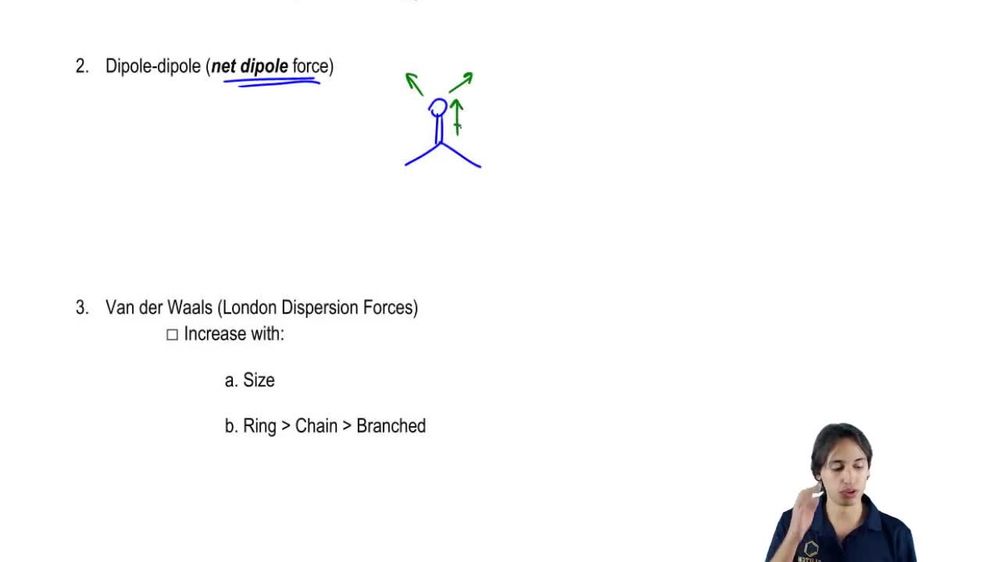
Understand the concept of dipole moment: Dipole moment (μ) is a measure of the separation of positive and negative charges in a molecule. It is a vector quantity, meaning it has both magnitude and direction.
Analyze the polarity of individual bonds: The N—F bond is more polar than the N—H bond because fluorine is more electronegative than hydrogen, leading to a greater difference in electronegativity between N and F compared to N and H.
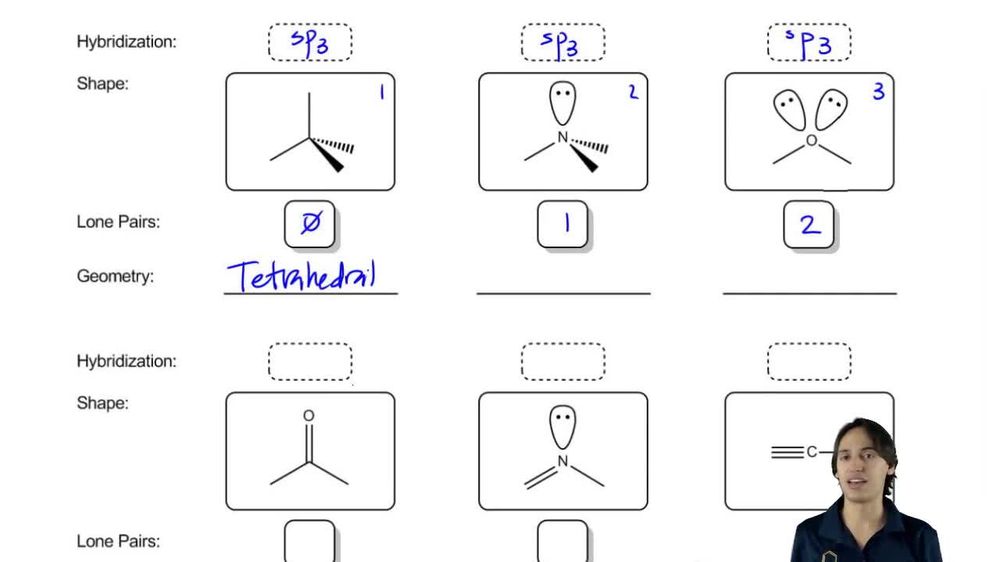
Consider the molecular geometry: Both NF3 and NH3 have a trigonal pyramidal shape due to the presence of a lone pair on the nitrogen atom. This shape affects how the individual bond dipoles add up to give the overall dipole moment of the molecule.
Evaluate the direction of bond dipoles: In NH3, the N—H bond dipoles are directed towards the nitrogen, and the lone pair also contributes to the dipole moment in the same direction, resulting in a larger overall dipole moment.
Assess the effect of lone pairs and bond dipoles in NF3: In NF3, the N—F bond dipoles are directed towards the fluorine atoms, but the lone pair on nitrogen has a dipole moment in the opposite direction, partially canceling out the bond dipoles, leading to a smaller overall dipole moment.
Verified video answer for a similar problem:
This video solution was recommended by our tutors as helpful for the problem above
Video duration:
4m
Play a video:
0 Comments
Key Concepts
Here are the essential concepts you must grasp in order to answer the question correctly.
Bond Polarity
Bond polarity refers to the distribution of electrical charge between atoms in a molecule. A bond is polar when there is a significant difference in electronegativity between the bonded atoms, causing a dipole moment. In NF3, the N—F bond is more polar than the N—H bond due to fluorine's higher electronegativity compared to hydrogen.
Molecular geometry is the three-dimensional arrangement of atoms within a molecule, influencing its dipole moment. NF3 and NH3 both have a trigonal pyramidal shape, but the orientation of the dipoles in NF3 leads to partial cancellation, resulting in a smaller overall dipole moment compared to NH3, where dipoles add constructively.
Dipole moment is a measure of the separation of positive and negative charges in a molecule, indicating its polarity. It depends on both the individual bond polarities and the molecular geometry. Despite NF3 having more polar bonds, its dipole moment is smaller than NH3 due to the vector sum of the bond dipoles being less effective in NF3.