Rank each group of compounds from most reactive to least reactive toward electrophilic aromatic substitution: e. p-methylnitrobenzene, 2-chloro-1-methyl-4-nitrobenzene, 1-methyl-2,4-dinitrobenzene, p-chloromethylbenzene
Verified step by step guidance
1
Step 1: Understand the concept of electrophilic aromatic substitution (EAS). EAS reactions involve the substitution of a hydrogen atom on an aromatic ring with an electrophile. The reactivity of the aromatic ring depends on the electronic effects of substituents already present on the ring, which can either activate or deactivate the ring toward electrophilic attack.
Step 2: Analyze the substituents on each compound. Substituents can be electron-donating groups (EDGs) or electron-withdrawing groups (EWGs). EDGs increase the electron density on the aromatic ring, making it more reactive toward electrophiles, while EWGs decrease the electron density, making the ring less reactive. For the given compounds:
- p-Methylnitrobenzene has a methyl group (EDG) and a nitro group (EWG).
- 2-Chloro-1-methyl-4-nitrobenzene has a chloro group (weak EWG), a methyl group (EDG), and a nitro group (strong EWG).
- 1-Methyl-2,4-dinitrobenzene has a methyl group (EDG) and two nitro groups (strong EWGs).
- p-Chloromethylbenzene has a methyl group (EDG) and a chloro group (weak EWG).
Step 3: Evaluate the net electronic effects of the substituents on the aromatic ring. Consider the relative strength of the activating and deactivating groups. For example, nitro groups are strong deactivators due to their strong electron-withdrawing nature, while methyl groups are weak activators. The presence of multiple nitro groups will significantly reduce the reactivity of the ring.
Step 4: Rank the compounds based on their reactivity toward EAS. The compound with the most electron-donating substituents and the least electron-withdrawing substituents will be the most reactive. Conversely, the compound with the most electron-withdrawing substituents will be the least reactive. Consider the positions of the substituents as well, as ortho/para-directing groups can influence the reactivity differently than meta-directing groups.
Step 5: Finalize the ranking. Based on the analysis, rank the compounds from most reactive to least reactive toward electrophilic aromatic substitution. Use the electronic effects of the substituents and their positions on the aromatic ring to determine the order.
Verified video answer for a similar problem:
This video solution was recommended by our tutors as helpful for the problem above
Video duration:
5m
Play a video:
0 Comments
Key Concepts
Here are the essential concepts you must grasp in order to answer the question correctly.
Electrophilic Aromatic Substitution (EAS)
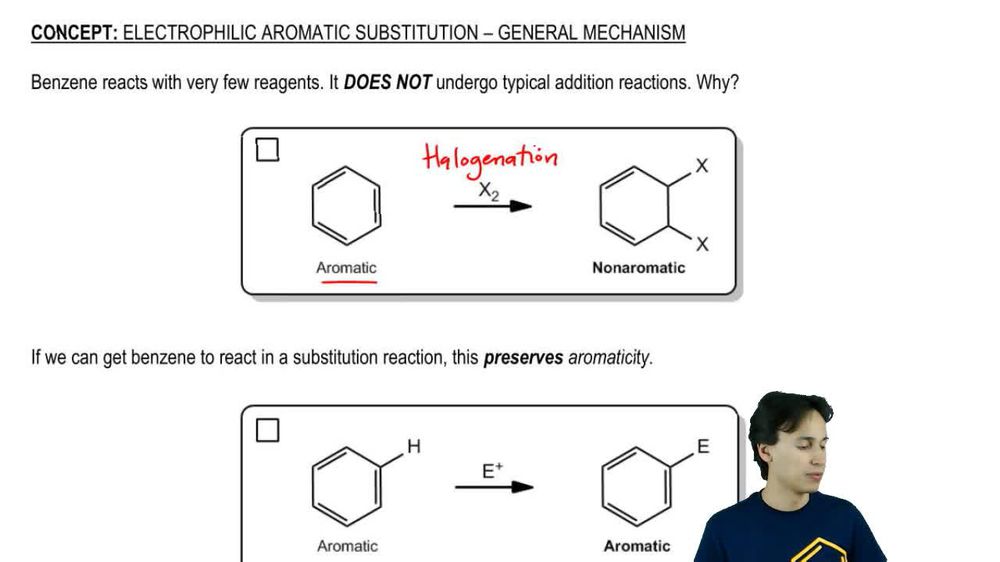
Electrophilic Aromatic Substitution is a fundamental reaction in organic chemistry where an electrophile replaces a hydrogen atom on an aromatic ring. The reactivity of the aromatic compound is influenced by the nature of substituents already present on the ring, which can either activate or deactivate the ring towards further substitution.
Substituents on an aromatic ring can be classified as activating or deactivating based on their electronic effects. Activating groups, such as alkyl groups, increase the electron density of the ring, making it more reactive towards electrophiles. In contrast, deactivating groups, like nitro groups, withdraw electron density, reducing reactivity and directing electrophilic attacks to specific positions on the ring.
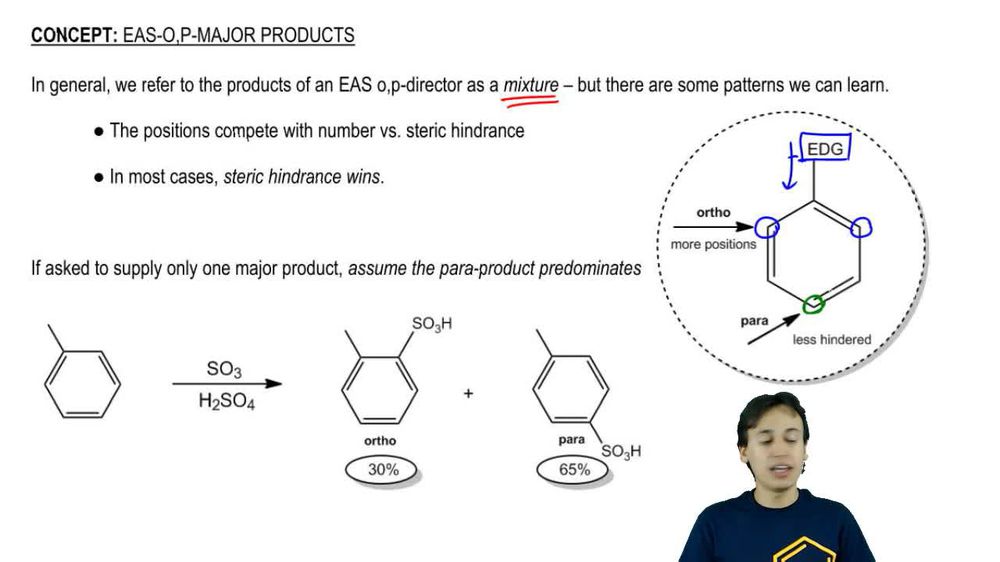
The position of substituents on an aromatic ring affects the site of electrophilic attack. Activating groups typically direct new substituents to the ortho and para positions, while deactivating groups often direct them to the meta position. Understanding these directing effects is crucial for predicting the reactivity and product distribution in electrophilic aromatic substitution reactions.