When pure (S)-lactic acid is esterified by racemic butan-2-ol, the product is 2-butyl lactate, with the following structure: (a) Draw three-dimensional structures of the two stereoisomers formed, specifying the configuration at each asymmetric carbon atom. (Using your models may be helpful.) (b) Determine the relationship between the two stereoisomers you have drawn
Verified step by step guidance
1
Step 1: Analyze the reaction. The esterification of (S)-lactic acid with racemic butan-2-ol produces 2-butyl lactate. The reaction involves the formation of an ester bond between the carboxylic acid group of lactic acid and the hydroxyl group of butan-2-ol.
Step 2: Identify the stereocenters. (S)-lactic acid has one stereocenter at the carbon bearing the hydroxyl group. Racemic butan-2-ol has one stereocenter at the carbon bearing the hydroxyl group. The product, 2-butyl lactate, will have two stereocenters: one from lactic acid and one from butan-2-ol.
Step 3: Draw the two stereoisomers of 2-butyl lactate. Since butan-2-ol is racemic, it contains both (R)- and (S)-enantiomers. When combined with (S)-lactic acid, the two possible products are (S,S)-2-butyl lactate and (S,R)-2-butyl lactate. Draw these structures in three dimensions, showing the configurations at each stereocenter.
Step 4: Determine the relationship between the two stereoisomers. The two stereoisomers, (S,S)-2-butyl lactate and (S,R)-2-butyl lactate, are diastereomers. Diastereomers are stereoisomers that are not mirror images of each other and have different physical and chemical properties.
Step 5: Verify the configurations. Use the Cahn-Ingold-Prelog priority rules to confirm the absolute configurations at each stereocenter in the two stereoisomers. This ensures that the structures are correctly assigned as (S,S) and (S,R).
Verified video answer for a similar problem:
This video solution was recommended by our tutors as helpful for the problem above
Video duration:
6m
Play a video:
0 Comments
Key Concepts
Here are the essential concepts you must grasp in order to answer the question correctly.
Stereochemistry
Stereochemistry is the study of the spatial arrangement of atoms in molecules and how this affects their chemical behavior. It is crucial for understanding isomerism, particularly in compounds with chiral centers, where the arrangement of substituents around the asymmetric carbon can lead to different stereoisomers. In this context, recognizing the configurations (R or S) of the chiral centers in lactic acid and butan-2-ol is essential for drawing the correct three-dimensional structures.
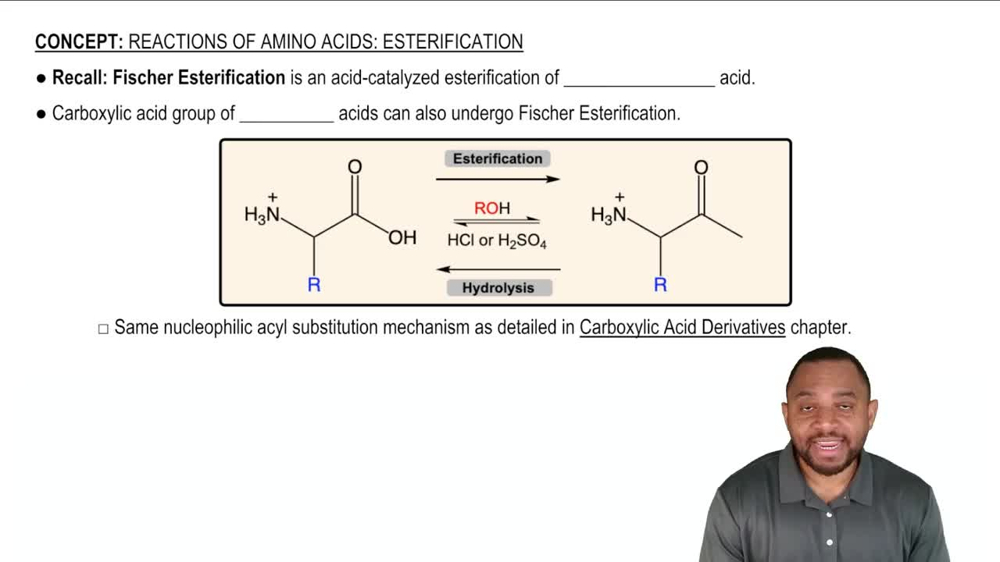
Esterification is a chemical reaction between an alcohol and a carboxylic acid, resulting in the formation of an ester and water. In this case, the reaction between (S)-lactic acid and racemic butan-2-ol produces 2-butyl lactate. Understanding the mechanism of esterification, including the role of the hydroxyl group and the carboxyl group, is important for predicting the products and their stereochemical outcomes.
Reactions of Amino Acids: Esterification Concept 1
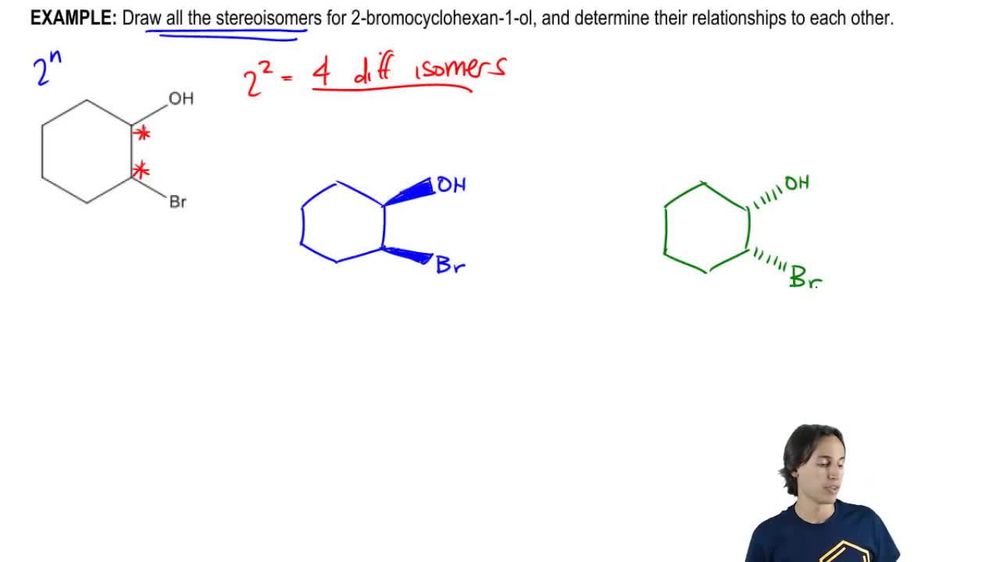
Stereoisomer Relationship
The relationship between stereoisomers can be classified as enantiomers or diastereomers, depending on their configurations. Enantiomers are non-superimposable mirror images, while diastereomers are not mirror images and differ at one or more chiral centers. In this question, determining whether the two stereoisomers of 2-butyl lactate are enantiomers or diastereomers is key to understanding their chemical properties and reactivity.

 6:04 minutes
 Verified step by step guidance
 1:38
1:38