From the following rate constants, determined at five temperatures, calculate the experimental energy of activation and ∆G‡, ∆H‡, and ∆S‡ for the reaction at 30 °C: <IMAGE>
Verified step by step guidance
1
Step 1: Use the Arrhenius equation to calculate the activation energy (Ea). The Arrhenius equation is k = A * exp(-Ea / (R * T)), where k is the rate constant, A is the pre-exponential factor, Ea is the activation energy, R is the gas constant (8.314 J/(mol·K)), and T is the temperature in Kelvin. Take the natural logarithm of both sides to linearize the equation: ln(k) = ln(A) - (Ea / R) * (1 / T). Plot ln(k) versus 1/T using the given data to determine the slope, which is equal to -Ea / R.
Step 2: Calculate the activation energy (Ea) from the slope of the plot. Multiply the slope by -R to find Ea. Ensure that the units of Ea are consistent, typically in joules per mole (J/mol) or kilojoules per mole (kJ/mol).
Step 3: To calculate the Gibbs free energy of activation (∆G‡) at 30 °C (303 K), use the equation ∆G‡ = -R * T * ln(k / k_B * T / h), where k_B is the Boltzmann constant (1.38 × 10^-23 J/K), h is Planck's constant (6.626 × 10^-34 J·s), and k is the rate constant at 30 °C. Substitute the known values and solve for ∆G‡.
Step 4: Calculate the enthalpy of activation (∆H‡) using the relationship ∆H‡ = Ea - RT, where Ea is the activation energy determined earlier, R is the gas constant, and T is the temperature in Kelvin (303 K).
Step 5: Calculate the entropy of activation (∆S‡) using the Gibbs free energy equation: ∆G‡ = ∆H‡ - T * ∆S‡. Rearrange to solve for ∆S‡: ∆S‡ = (∆H‡ - ∆G‡) / T. Substitute the values of ∆H‡, ∆G‡, and T to find ∆S‡.
Verified video answer for a similar problem:
This video solution was recommended by our tutors as helpful for the problem above
Video duration:
16m
Play a video:
0 Comments
Key Concepts
Here are the essential concepts you must grasp in order to answer the question correctly.
Arrhenius Equation
The Arrhenius equation relates the rate constant of a reaction to temperature and activation energy. It is expressed as k = A * e^(-Ea/RT), where k is the rate constant, A is the pre-exponential factor, Ea is the activation energy, R is the gas constant, and T is the temperature in Kelvin. Understanding this equation is crucial for calculating the energy of activation from the provided rate constants.
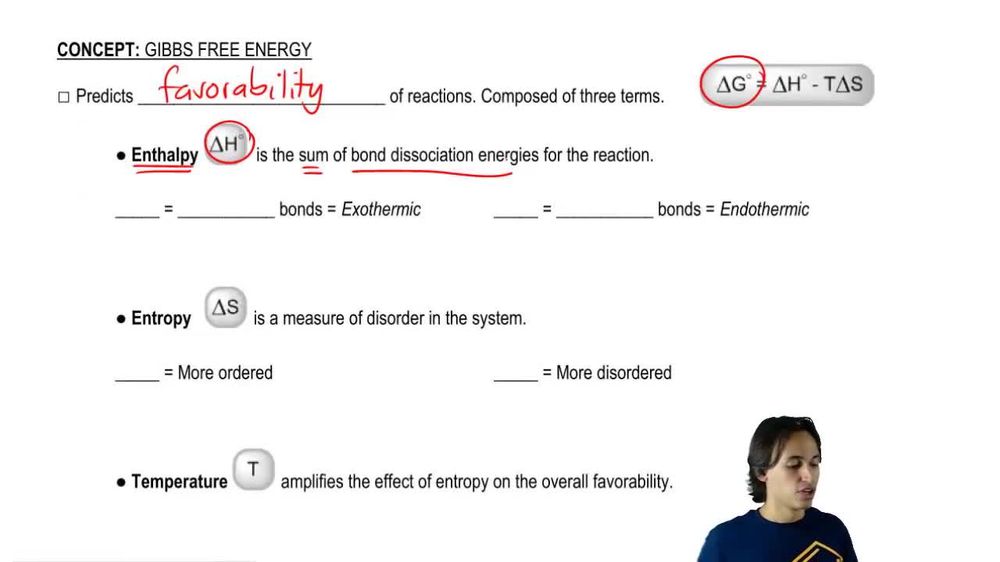
Breaking down the different terms of the Gibbs Free Energy equation.
Gibbs Free Energy of Activation (∆G‡)
The Gibbs free energy of activation (∆G‡) is a thermodynamic parameter that indicates the energy barrier for a reaction to proceed. It can be calculated using the relationship ∆G‡ = ∆H‡ - T∆S‡, where ∆H‡ is the enthalpy of activation and ∆S‡ is the entropy of activation. This concept is essential for understanding the spontaneity and rate of the reaction at a given temperature.
Breaking down the different terms of the Gibbs Free Energy equation.
Enthalpy and Entropy of Activation (∆H‡ and ∆S‡)
The enthalpy of activation (∆H‡) represents the heat energy required to reach the transition state, while the entropy of activation (∆S‡) reflects the change in disorder associated with the formation of the transition state. These parameters can be derived from the temperature dependence of the rate constants and are vital for characterizing the energy landscape of the reaction.