Using a 60-MHz spectrometer, a chemist observes the following absorption: doublet, J = 7 Hz, at δ4.00 (a) What would the chemical shift (δ) be in the 300-MHz spectrum? (b) What would the splitting value J be in the 300-MHz spectrum? (c) How many hertz from the TMS peak is this absorption in the 60-MHz spectrum? In the 300-MHz spectrum?
Verified step by step guidance
1
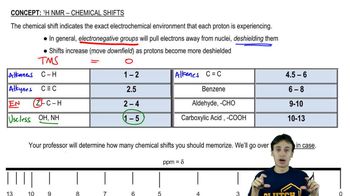
Step 1: Understand the relationship between chemical shift (δ) and the spectrometer frequency. The chemical shift (δ) is a dimensionless value expressed in parts per million (ppm) and is independent of the spectrometer frequency. Therefore, the δ value remains the same regardless of the spectrometer frequency.
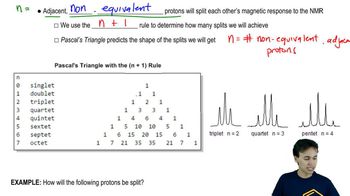
Step 2: Recognize that the coupling constant (J) is measured in hertz (Hz) and is independent of the spectrometer frequency. This means the J value will remain the same regardless of whether the spectrometer is 60 MHz or 300 MHz.
Step 3: Calculate the distance in hertz from the TMS peak for the 60-MHz spectrum. Use the formula: distance (Hz) = δ (ppm) × spectrometer frequency (MHz). For the 60-MHz spectrum, substitute δ = 4.00 ppm and spectrometer frequency = 60 MHz into the formula.
Step 4: Calculate the distance in hertz from the TMS peak for the 300-MHz spectrum. Use the same formula: distance (Hz) = δ (ppm) × spectrometer frequency (MHz). For the 300-MHz spectrum, substitute δ = 4.00 ppm and spectrometer frequency = 300 MHz into the formula.
Step 5: Summarize the results. The chemical shift (δ) remains the same at 4.00 ppm for both spectrometers. The coupling constant (J) remains the same at 7 Hz for both spectrometers. The distance in hertz from the TMS peak will differ between the 60-MHz and 300-MHz spectrometers, as calculated in steps 3 and 4.
Verified video answer for a similar problem:
This video solution was recommended by our tutors as helpful for the problem above
Video duration:
5m
Play a video:
0 Comments
Key Concepts
Here are the essential concepts you must grasp in order to answer the question correctly.
Chemical Shift
Chemical shift (δ) refers to the resonant frequency of a nucleus relative to a standard reference, typically tetramethylsilane (TMS) in NMR spectroscopy. It is measured in parts per million (ppm) and provides insight into the electronic environment surrounding the nuclei. The chemical shift can change with the frequency of the spectrometer, but the relative position remains constant, allowing for comparisons across different instruments.
J-coupling, or spin-spin splitting, occurs when nuclei interact with each other through chemical bonds, leading to the splitting of NMR signals into multiple peaks. The coupling constant (J) quantifies the interaction strength and is measured in hertz (Hz). This value remains constant regardless of the spectrometer frequency, allowing for consistent interpretation of splitting patterns across different NMR instruments.
The frequency of an NMR spectrometer, measured in megahertz (MHz), affects the sensitivity and resolution of the spectra obtained. While the chemical shift values (δ) are independent of the spectrometer frequency, the absolute frequency of the resonance peaks will change. Understanding how to convert between different spectrometer frequencies is essential for accurate analysis and comparison of NMR data.