An aromatic hydrocarbon with a molecular formula of C13H20 has an 1H NMR spectrum with a signal at ~7 ppm that integrates to 5H. It also has two singlets; one of the singlets has 1.5 times the area of the second. What is the structure of the aromatic hydrocarbon?
Verified step by step guidance
1
Analyze the molecular formula C13H20: This indicates the compound is an aromatic hydrocarbon. Aromatic hydrocarbons typically contain a benzene ring (C6H6) as part of their structure. The remaining carbons and hydrogens must account for the substituents attached to the benzene ring.
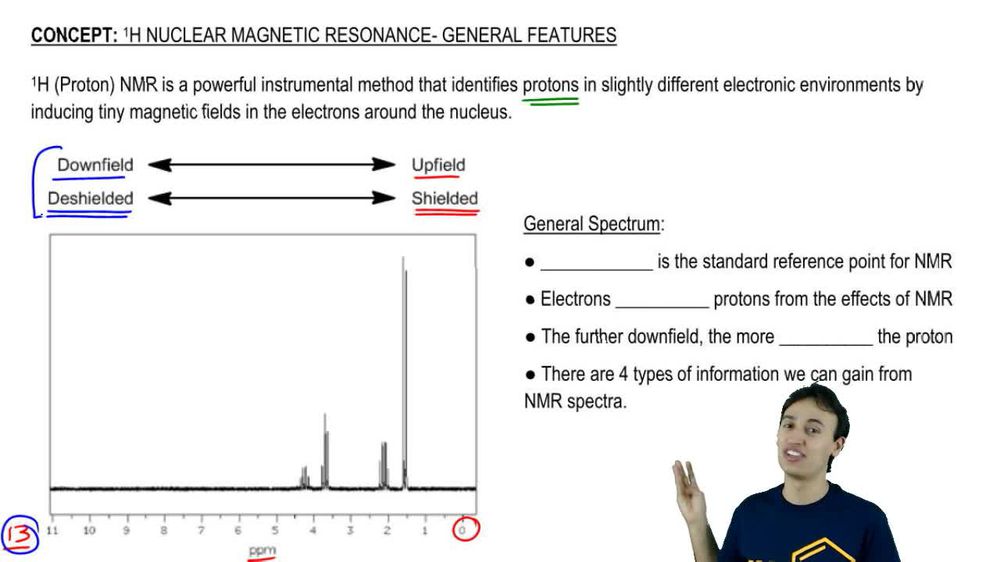
Interpret the 1H NMR signal at ~7 ppm: A signal in this region is characteristic of aromatic protons. The integration of 5H suggests that the benzene ring is monosubstituted, leaving five hydrogens on the ring to contribute to the signal.
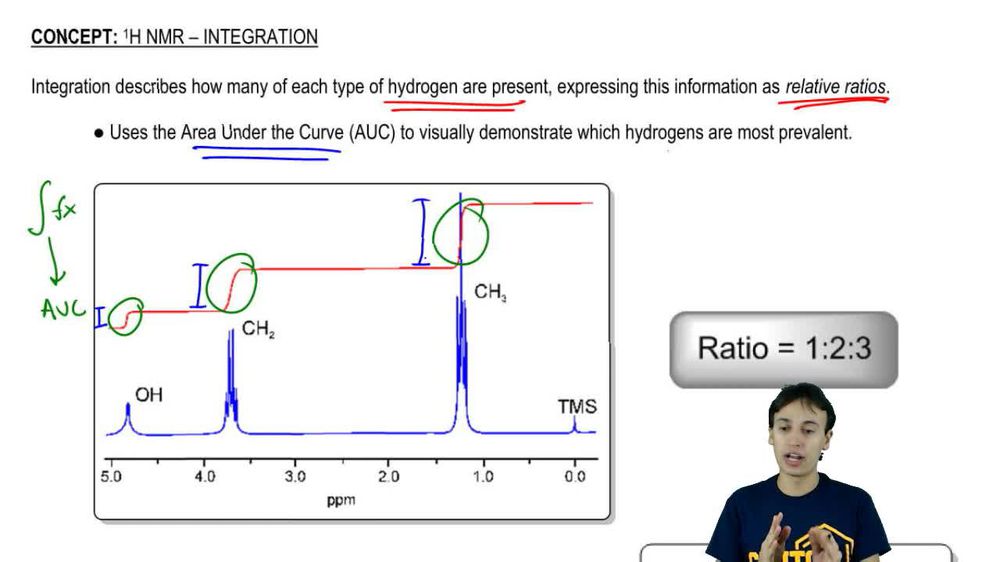
Examine the two singlets: Singlets in the 1H NMR spectrum indicate protons that are not coupled to neighboring protons. The fact that one singlet has 1.5 times the area of the other suggests a ratio of 3:2 for the protons contributing to these signals. This is consistent with a tert-butyl group (C(CH3)3, contributing 9H) and an isopropyl group (CH(CH3)2, contributing 6H).
Propose the substitution pattern: A tert-butyl group and an isopropyl group are likely attached to the benzene ring. The tert-butyl group contributes 9H (appearing as a singlet due to symmetry), and the isopropyl group contributes 6H (appearing as a singlet for the two equivalent methyl groups).
Construct the structure: Combine the benzene ring with a tert-butyl group and an isopropyl group as substituents. The substitution pattern should be consistent with the integration of the aromatic protons (5H) and the singlets (3:2 ratio). Verify the molecular formula (C13H20) and the NMR data to confirm the structure.
Verified video answer for a similar problem:
This video solution was recommended by our tutors as helpful for the problem above
Play a video:
0 Comments
Key Concepts
Here are the essential concepts you must grasp in order to answer the question correctly.
Aromatic Hydrocarbons
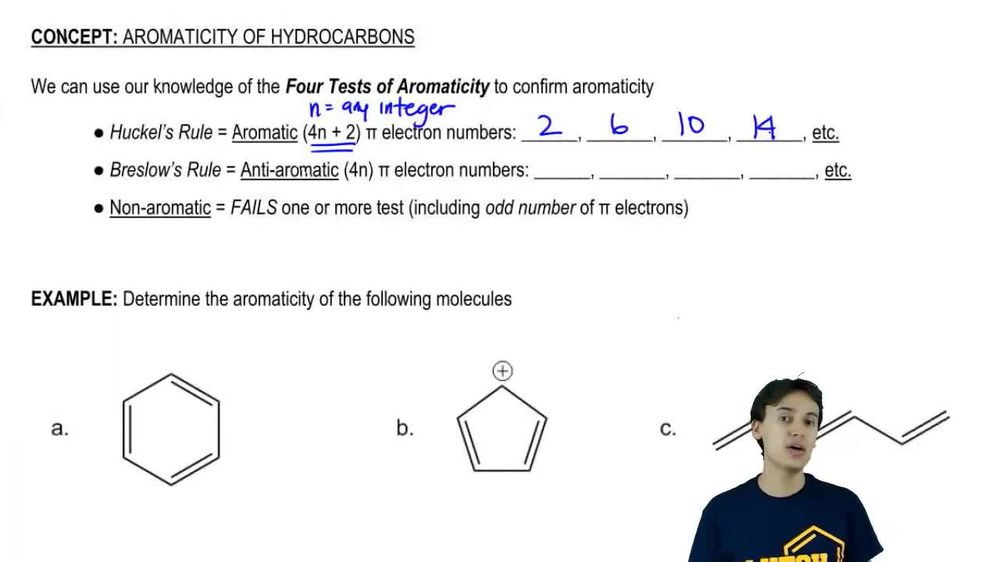
Aromatic hydrocarbons are compounds that contain one or more benzene rings, characterized by their stability and unique electronic structure due to resonance. They follow Huckel's rule, which states that a cyclic, planar molecule with a certain number of pi electrons (4n + 2) is aromatic. Understanding the structure and properties of aromatic compounds is essential for interpreting NMR data.
NMR spectroscopy is a powerful analytical technique used to determine the structure of organic compounds. In 1H NMR, the chemical environment of hydrogen atoms is revealed through shifts in resonance frequency, measured in parts per million (ppm). The integration of signals indicates the relative number of protons contributing to each signal, which helps deduce the molecular structure.
In NMR, the area under each signal (integration) corresponds to the number of protons contributing to that signal. Singlets indicate that the protons are not coupled to neighboring protons, while the ratio of the areas can provide insight into the relative number of different types of protons in the molecule. Understanding these patterns is crucial for deducing the structure of the compound based on the given NMR data.