Which of the bonds in a carbon–oxygen double bond has more effective orbital–orbital overlap: the σ bond or the π bond?
Verified step by step guidance
1
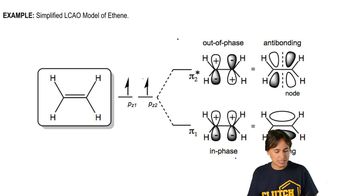
Understand the nature of the bonds in a carbon–oxygen double bond. A double bond consists of one sigma (σ) bond and one pi (π) bond. The σ bond is formed by the head-on overlap of orbitals, while the π bond is formed by the side-by-side overlap of p orbitals.
Recall that the effectiveness of orbital–orbital overlap depends on the geometry of the interaction. Head-on overlap in a σ bond allows for greater overlap compared to the side-by-side overlap in a π bond.
Consider the orbitals involved in the σ bond. In a carbon–oxygen double bond, the σ bond is typically formed by the overlap of a sp² hybrid orbital from carbon and a sp² hybrid orbital from oxygen. These hybrid orbitals are oriented directly along the bond axis, maximizing overlap.
Now consider the orbitals involved in the π bond. The π bond is formed by the unhybridized p orbitals on carbon and oxygen, which are perpendicular to the bond axis. The side-by-side overlap of these p orbitals is less effective compared to the head-on overlap in the σ bond.
Conclude that the σ bond in a carbon–oxygen double bond has more effective orbital–orbital overlap than the π bond due to the geometry and type of orbital interaction involved.
Verified video answer for a similar problem:
This video solution was recommended by our tutors as helpful for the problem above
Video duration:
3m
Play a video:
0 Comments
Key Concepts
Here are the essential concepts you must grasp in order to answer the question correctly.
Sigma (σ) and Pi (π) Bonds
Sigma (σ) bonds are formed by the head-on overlap of atomic orbitals, allowing for a strong bond with cylindrical symmetry around the bond axis. In contrast, pi (π) bonds result from the side-to-side overlap of p orbitals, which is generally weaker due to less effective overlap. Understanding the differences in formation and strength between these bond types is crucial for analyzing double bonds.
Orbital overlap refers to the extent to which atomic orbitals from two atoms share space and interact when forming a bond. Greater overlap leads to stronger bonds. In a carbon-oxygen double bond, the σ bond has more effective overlap than the π bond, which is essential for understanding the stability and reactivity of such bonds in organic compounds.
The strength and stability of a bond are influenced by the type of bonds present and their respective overlaps. Sigma bonds are generally stronger and more stable than pi bonds due to their effective overlap. In a carbon-oxygen double bond, the presence of both σ and π bonds means that while the σ bond provides significant stability, the π bond contributes to the overall reactivity of the molecule.