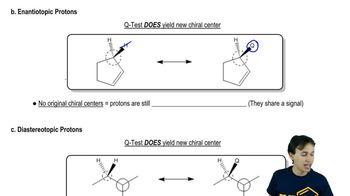
If the imaginary replacement of either of two protons forms enantiomers, then those protons are said to be enantiotopic. The NMR is not a chiral probe, and it cannot distinguish between enantiotopic protons. They are seen to be “equivalent by NMR.” (a) Use the imaginary replacement technique to show that the two allylic protons (those on C3) of allyl bromide are enantiotopic.
Verified step by step guidance
1
Identify the allylic protons on C3 of allyl bromide. Allyl bromide has the structure CH2=CH-CH2Br. The two protons on the CH2 group (C3) are the ones in question.
Apply the imaginary replacement technique. Replace one of the protons on C3 with a hypothetical group, such as a deuterium atom (D), and analyze the resulting molecule.
Determine the stereochemical relationship of the resulting molecules. If replacing one proton with D creates a molecule that is the mirror image of the molecule formed by replacing the other proton with D, then the protons are enantiotopic.
Visualize the symmetry of the molecule. Allyl bromide is not a chiral molecule, but replacing one proton on C3 breaks the symmetry and introduces chirality. The two resulting molecules (one with D replacing the first proton and the other with D replacing the second proton) will be non-superimposable mirror images, confirming that the protons are enantiotopic.
Conclude that since the two protons on C3 are enantiotopic, they are equivalent in an achiral environment such as NMR spectroscopy. This is why they appear as a single signal in the NMR spectrum.
Verified video answer for a similar problem:
This video solution was recommended by our tutors as helpful for the problem above
Video duration:
2m
Play a video:
0 Comments
Key Concepts
Here are the essential concepts you must grasp in order to answer the question correctly.
Enantiotopic Protons
Enantiotopic protons are pairs of protons in a molecule that, when one is replaced by a different atom or group, result in the formation of enantiomers. This means that the two protons are not equivalent in terms of their chemical environment, even though they may appear similar. The concept is crucial for understanding stereochemistry and how molecular symmetry affects reactivity and properties.
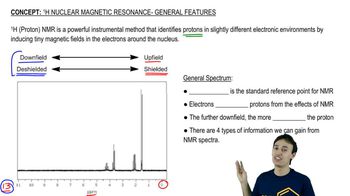
NMR spectroscopy is a powerful analytical technique used to determine the structure of organic compounds. It relies on the magnetic properties of certain nuclei, such as hydrogen, to provide information about the environment of atoms in a molecule. However, NMR cannot differentiate between enantiotopic protons, as they are chemically equivalent in the context of the NMR experiment, leading to overlapping signals.
The imaginary replacement technique is a theoretical approach used to analyze the stereochemical relationships between protons in a molecule. By conceptually replacing one proton with a different atom or group, chemists can assess whether the resulting structure is chiral or achiral. This method is particularly useful for identifying enantiotopic protons and understanding their role in stereochemistry.