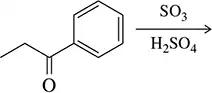
Predict the products of the following electrophilic aromatic substitution reactions. (b)
Verified step by step guidance
1
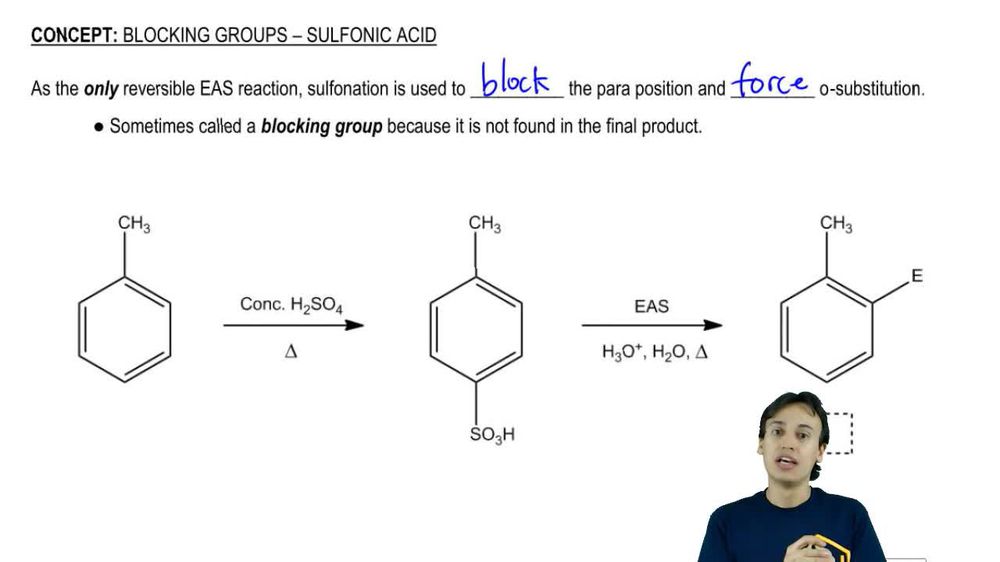
Identify the type of reaction: The reaction shown is an electrophilic aromatic substitution (EAS) where a sulfonation reaction is taking place. The reagents SO3 and H2SO4 are used to introduce a sulfonic acid group (SO3H) onto the aromatic ring.
Determine the directing effects of substituents: The acyl group (C=O) attached to the benzene ring is a meta-directing group due to its electron-withdrawing nature. This means that the incoming electrophile (SO3) will preferentially add to the meta position relative to the acyl group.
Draw the intermediate: The electrophile, SO3, will attack the benzene ring at the meta position, forming a sigma complex (arenium ion) where the positive charge is delocalized over the ring.
Reform the aromatic system: The loss of a proton from the sigma complex will restore the aromaticity of the benzene ring, resulting in the formation of the sulfonated product.
Predict the final product: The final product will be a benzene ring with a sulfonic acid group (SO3H) at the meta position relative to the acyl group, due to the directing effects of the acyl substituent.
Verified video answer for a similar problem:
This video solution was recommended by our tutors as helpful for the problem above
Play a video:
0 Comments
Key Concepts
Here are the essential concepts you must grasp in order to answer the question correctly.
Electrophilic Aromatic Substitution (EAS)
Electrophilic Aromatic Substitution is a reaction where an aromatic ring, such as benzene, undergoes substitution of one of its hydrogen atoms by an electrophile. This process involves the formation of a highly reactive intermediate called an arenium ion, which is stabilized by resonance. The reaction typically proceeds through two main steps: the formation of the arenium ion and the subsequent deprotonation to restore aromaticity.
Sulfonation is a type of electrophilic aromatic substitution where sulfur trioxide (SO3) acts as the electrophile, often in the presence of sulfuric acid (H2SO4) to form the sulfonic acid group (-SO3H) on the aromatic ring. This reaction is reversible and is used to introduce sulfonic acid groups into aromatic compounds, which can influence the compound's solubility and reactivity.
In EAS reactions, substituents already present on the aromatic ring can influence the position where new groups are added. Electron-withdrawing groups, like the carbonyl group in an acyl group, typically direct incoming electrophiles to the meta position relative to themselves. This is due to their ability to stabilize the arenium ion intermediate through resonance and inductive effects, affecting the regioselectivity of the reaction.

 Verified step by step guidance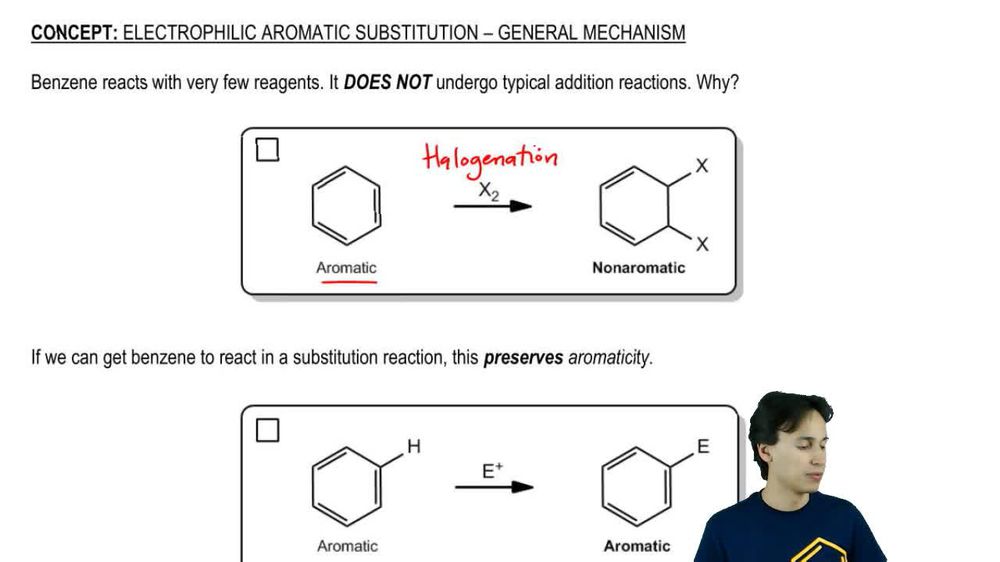
 03:07
03:07