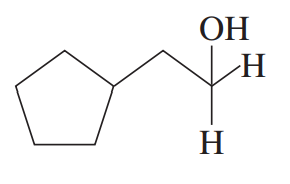
Show how this 1° alcohol can be made from the following: (e) an alkene (f) ethylene oxide
Verified step by step guidance
1
Step 1: To synthesize the given 1° alcohol from an alkene, identify the corresponding alkene structure. The alcohol shown has a hydroxyl group (-OH) attached to a primary carbon. The alkene precursor would be cyclopentyl ethene (cyclopentyl group attached to a double bond).
Step 2: Perform hydroboration-oxidation on the alkene. This reaction involves two steps: (a) Add BH₃ (borane) or a borane derivative to the alkene to form an organoborane intermediate. (b) Oxidize the organoborane intermediate using H₂O₂ (hydrogen peroxide) in a basic solution (NaOH). This results in anti-Markovnikov addition of water, forming the 1° alcohol.
Step 3: To synthesize the given 1° alcohol from ethylene oxide, identify the nucleophile that can attack the ethylene oxide ring. The nucleophile in this case would be cyclopentylmethyl anion (generated from cyclopentylmethyl bromide using a strong base like NaH).
Step 4: Perform a ring-opening reaction of ethylene oxide. The nucleophile attacks the less hindered carbon of the ethylene oxide ring, leading to the formation of a primary alcohol. This reaction is typically carried out in an aqueous or alcohol solvent.
Step 5: After the ring-opening reaction, ensure the product matches the structure of the desired 1° alcohol. Verify that the hydroxyl group is attached to the primary carbon and the cyclopentyl group is intact.
Verified video answer for a similar problem:
This video solution was recommended by our tutors as helpful for the problem above
Video duration:
4m
Play a video:
0 Comments
Key Concepts
Here are the essential concepts you must grasp in order to answer the question correctly.
Alcohol Synthesis from Alkenes
The conversion of alkenes to alcohols typically involves hydration reactions. This can be achieved through acid-catalyzed hydration, where water adds across the double bond of the alkene, or through hydroboration-oxidation, which provides anti-Markovnikov addition. Understanding the mechanism and regioselectivity of these reactions is crucial for synthesizing the desired primary alcohol.
Ethylene oxide is a cyclic ether that can be used to produce alcohols through ring-opening reactions. When reacted with nucleophiles, such as alcohols or water, the strained ring opens, leading to the formation of a primary alcohol. This reaction is significant in organic synthesis, particularly for creating alcohols with specific stereochemistry.
Regioselectivity refers to the preference of a chemical reaction to yield one structural isomer over others when multiple possibilities exist. In the context of alcohol synthesis, understanding regioselectivity is essential to predict the major product formed from alkenes or cyclic ethers, ensuring the correct primary alcohol is synthesized based on the reaction conditions and reagents used.