Hydrogen peroxide (HOOH) has a pKa of 11.6, making it roughly 10,000 times as strong an acid as water (pKa = 15.7). Explain why H2O2 is a stronger acid than H2O.
Verified step by step guidance
1
Understand the concept of pKa: The pKa value is a measure of the strength of an acid. A lower pKa value indicates a stronger acid because it implies the acid more readily donates protons (H⁺ ions) in solution.
Compare the pKa values: Hydrogen peroxide (HOOH) has a pKa of 11.6, while water (H₂O) has a pKa of 15.7. Since 11.6 is lower than 15.7, HOOH is a stronger acid than H₂O.
Analyze the molecular structure: The O-O bond in hydrogen peroxide is weaker and more polar than the O-H bond in water. This makes it easier for HOOH to donate a proton, contributing to its stronger acidic nature.
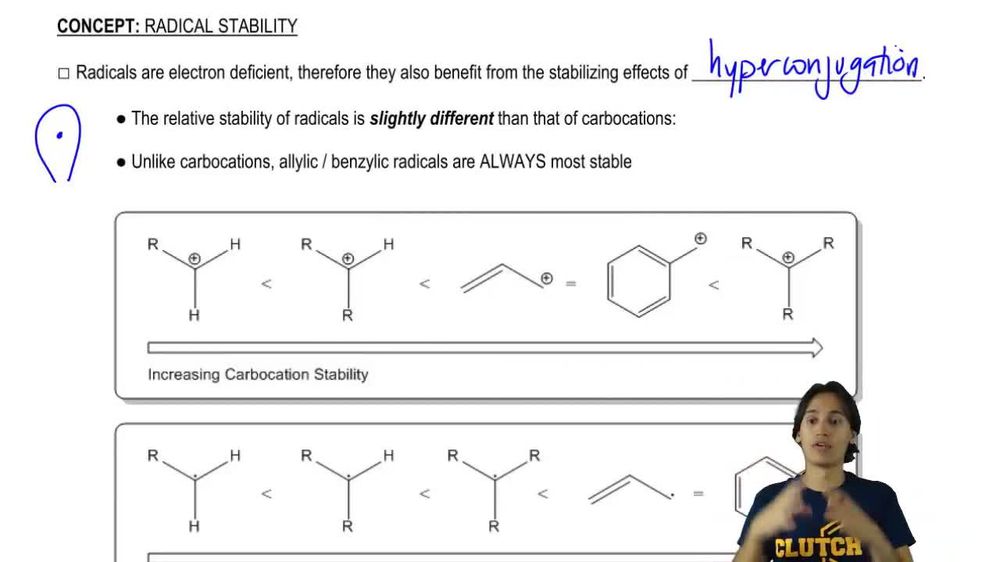
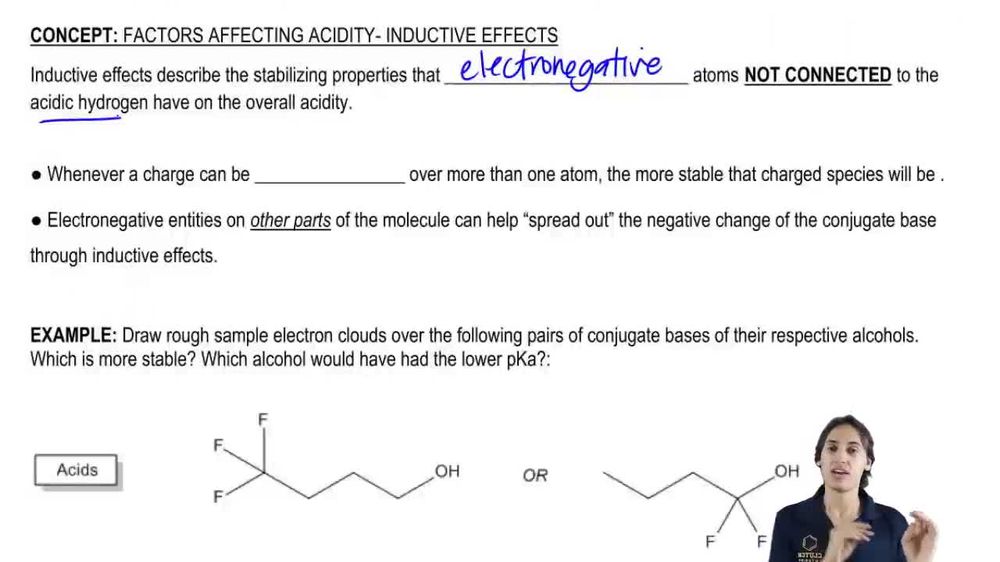
Consider the stability of the conjugate base: When HOOH donates a proton, it forms the conjugate base HO₂⁻. The presence of an additional oxygen atom in HO₂⁻ compared to OH⁻ (the conjugate base of water) can stabilize the negative charge through resonance and inductive effects, making the conjugate base more stable.
Relate acidity to conjugate base stability: The greater stability of the conjugate base (HO₂⁻) compared to OH⁻ is a key reason why HOOH is a stronger acid than H₂O. A more stable conjugate base corresponds to a stronger acid.
Verified video answer for a similar problem:
This video solution was recommended by our tutors as helpful for the problem above
Video duration:
3m
Play a video:
0 Comments
Key Concepts
Here are the essential concepts you must grasp in order to answer the question correctly.
Acid Strength and pKa
The strength of an acid is determined by its ability to donate protons (H+ ions) in solution. The pKa value is a logarithmic measure of this ability; lower pKa values indicate stronger acids. Hydrogen peroxide (H2O2) has a pKa of 11.6, which is lower than water's pKa of 15.7, indicating that H2O2 is a stronger acid than H2O.
The molecular structure of a compound affects its acidity. In hydrogen peroxide, the presence of the O-O bond and the additional oxygen atom can stabilize the negative charge on the conjugate base (HO2-) after losing a proton, more effectively than in water (OH-). This increased stability of the conjugate base contributes to H2O2's stronger acidity.
Resonance and inductive effects can influence acid strength. In H2O2, the electronegative oxygen atoms can delocalize the negative charge through resonance, stabilizing the conjugate base. Additionally, the inductive effect from the extra oxygen atom in H2O2 can pull electron density away, making it easier for the molecule to release a proton, thus enhancing its acidity compared to water.