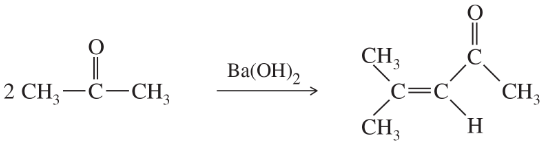
For practice in recognizing mechanisms, classify each reaction according to the type of mechanism you expect: 1. Free-radical chain reaction 2. Reaction involving strong bases and strong nucleophiles 3. Reaction involving strong acids and strong electrophiles (a)
Verified step by step guidance
1
Examine the reactants and products in the given reaction. The reactants are two molecules of acetone (CH₃COCH₃) and the reagent is barium hydroxide (Ba(OH)₂). The product is an aldol condensation product, which is a β-hydroxy ketone.
Recognize that the presence of Ba(OH)₂ suggests a reaction involving a strong base. Barium hydroxide is a strong base that can deprotonate the α-hydrogen of acetone, forming an enolate ion.
Understand the mechanism: The enolate ion formed from acetone acts as a nucleophile and attacks the carbonyl carbon of another acetone molecule, leading to the formation of a new carbon-carbon bond.
Identify the type of reaction: This is an aldol condensation reaction, which typically involves strong bases and nucleophiles. The enolate ion is a strong nucleophile, and the carbonyl carbon is an electrophile.
Classify the reaction: Based on the mechanism and the involvement of strong bases and nucleophiles, this reaction falls under category B: Reaction involving strong bases and strong nucleophiles.
Verified video answer for a similar problem:
This video solution was recommended by our tutors as helpful for the problem above
Video duration:
2m
Play a video:
0 Comments
Key Concepts
Here are the essential concepts you must grasp in order to answer the question correctly.
Free-Radical Chain Reactions
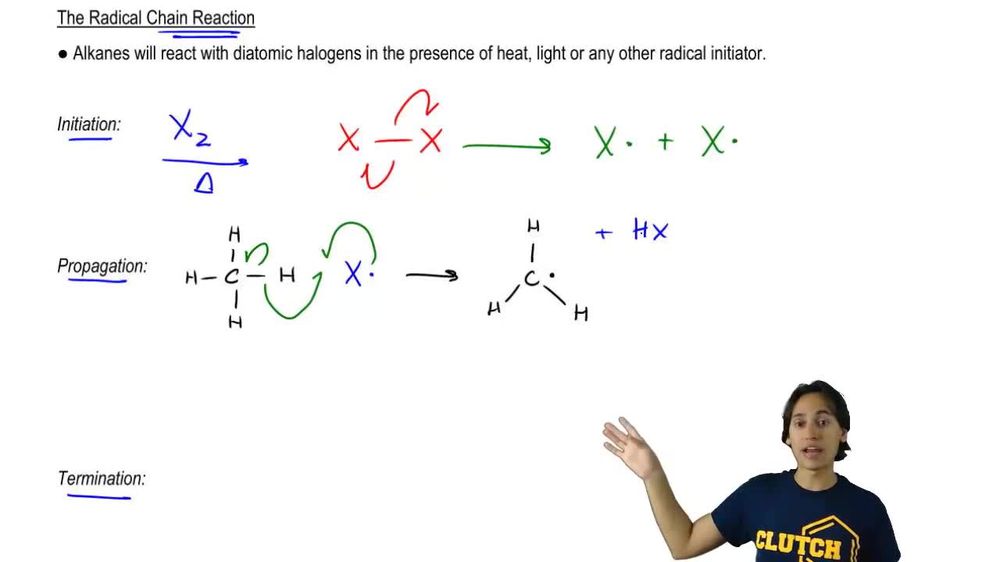
Free-radical chain reactions involve a series of steps including initiation, propagation, and termination, where free radicals are generated and react with stable molecules. These reactions are characterized by the formation of new radicals that continue the reaction cycle. Common examples include the halogenation of alkanes, where a halogen radical abstracts a hydrogen atom, leading to a chain reaction.
Nucleophiles are species that donate an electron pair to form a chemical bond, while electrophiles are electron-deficient species that accept an electron pair. Strong bases often act as nucleophiles, attacking electrophilic centers in reactions. Understanding the roles of these species is crucial for predicting reaction mechanisms and outcomes in organic chemistry.
The mechanism of an organic reaction describes the step-by-step process by which reactants are converted into products, detailing the breaking and forming of bonds. Mechanisms can be classified based on the nature of the reactants and the conditions, such as whether they involve ionic or radical pathways. Recognizing these mechanisms helps in understanding reaction conditions and predicting product formation.