For each structure shown, draw the two chair conformations and choose which is most stable. Be sure that your second chair is the flipped version of the first. [Make sure that wedged substituents are up in the chair, regardless of whether up is equatorial or axial.] (e)
Verified step by step guidance
1
Identify the substituents on the cyclohexane ring and their positions (e.g., axial or equatorial) based on the given structure. Remember that wedged substituents are 'up' and dashed substituents are 'down' in the chair conformation.
Draw the first chair conformation of cyclohexane. Place the substituents in their respective axial or equatorial positions, ensuring that 'up' substituents are correctly oriented as either axial up or equatorial up.
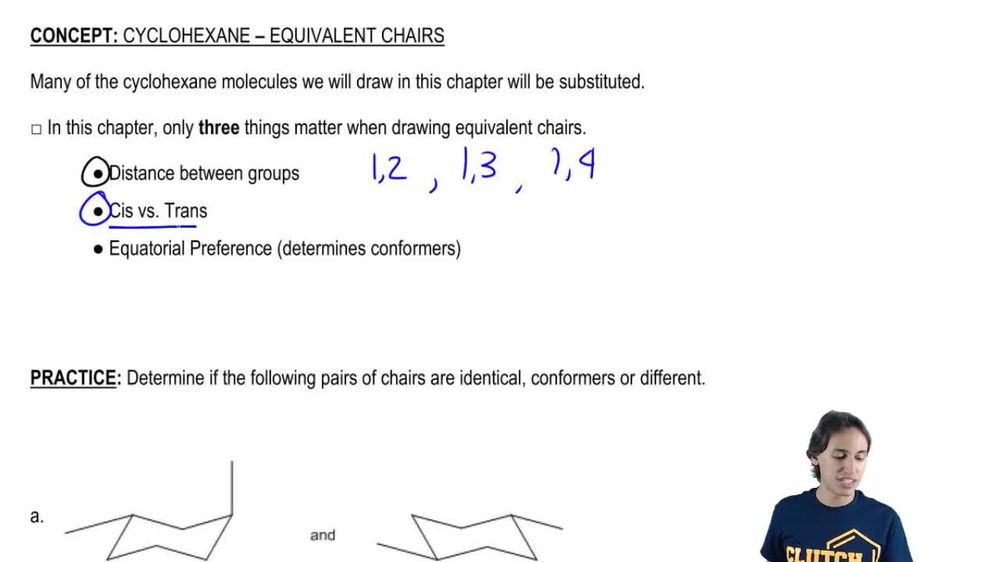
Perform a chair flip to draw the second chair conformation. In the flipped chair, axial substituents become equatorial, and equatorial substituents become axial, while maintaining their 'up' or 'down' orientation.
Analyze the stability of each chair conformation. Stability is influenced by steric hindrance: bulky groups prefer the equatorial position to minimize 1,3-diaxial interactions.
Compare the two chair conformations and determine which is more stable based on the placement of substituents (e.g., fewer steric interactions in the equatorial position).
Verified video answer for a similar problem:
This video solution was recommended by our tutors as helpful for the problem above
Video duration:
4m
Play a video:
0 Comments
Key Concepts
Here are the essential concepts you must grasp in order to answer the question correctly.
Chair Conformation
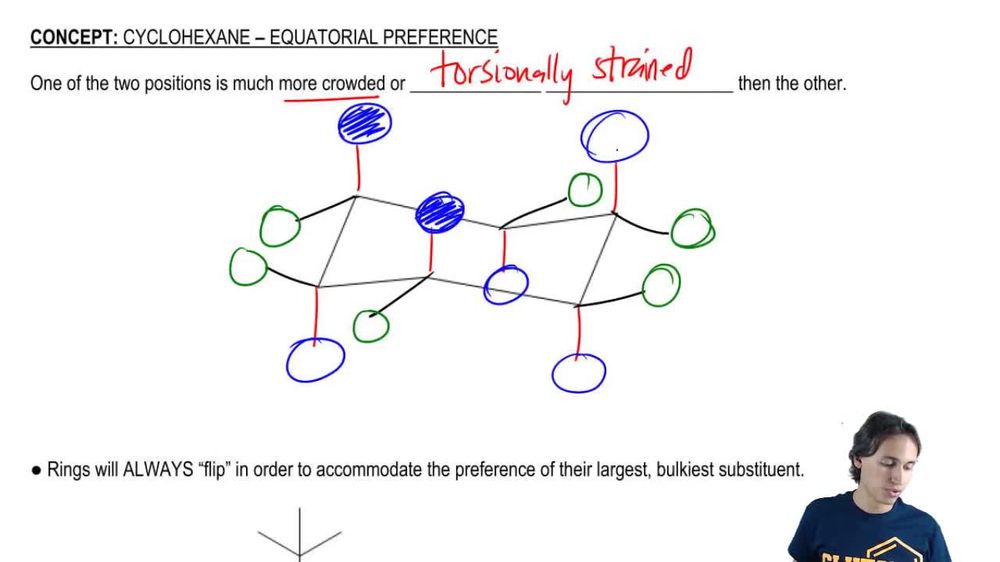
The chair conformation is a three-dimensional representation of cyclohexane that minimizes steric strain and torsional strain. In this conformation, carbon atoms are arranged in a staggered manner, allowing for more stable interactions between substituents. Understanding chair conformations is crucial for analyzing the stability of cyclohexane derivatives, as substituents can occupy equatorial or axial positions, influencing overall stability.
In the chair conformation of cyclohexane, substituents can occupy two types of positions: equatorial and axial. Equatorial substituents extend outward from the ring, minimizing steric hindrance with other groups, while axial substituents point vertically, which can lead to 1,3-diaxial interactions that increase steric strain. The stability of a molecule often depends on the preference for substituents to be in equatorial positions.
Flipping the chair conformation involves rotating the cyclohexane ring to convert axial substituents to equatorial and vice versa. This process is essential for comparing the stability of different conformations of the same molecule. By analyzing both chair forms, one can determine which conformation is more stable based on the positioning of substituents and the resulting steric interactions.

 4:24 minutes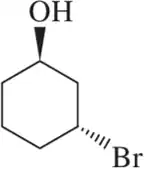
 Verified step by step guidance
 03:29
03:29