
Iodination of alkanes using iodine (I2) is usually an unfavorable reaction. (See Problem 4-17 , for example.) Tetraiodomethane (CI4) can be used as the iodine source for iodination in the presence of a free-radical initiator such as hydrogen peroxide. Propose a mechanism (involving mildly exothermic propagation steps) for the following proposed reaction. Calculate the value of ΔH for each of the steps in your proposed mechanism. The following bond-dissociation energies maybe helpful:
Verified step by step guidance
1
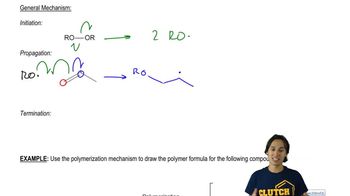
Step 1: Initiation - The reaction begins with the homolytic cleavage of the O-O bond in hydrogen peroxide (H₂O₂) under heat. This generates two hydroxyl radicals (•OH). The bond dissociation energy for HO-OH is 213 kJ/mol.
Step 2: Radical generation - One hydroxyl radical reacts with tetraiodomethane (CI₄), breaking the I₃C-I bond homolytically to form a triiodomethyl radical (•I₃C) and HO-I. The bond dissociation energy for I₃C-I is 188 kJ/mol, and for HO-I is 234 kJ/mol.
Step 3: Propagation - The triiodomethyl radical (•I₃C) abstracts a hydrogen atom from cyclopentane, forming cyclopentyl radical (•C₅H₉) and I₃C-H. The bond dissociation energy for I₃C-H is 418 kJ/mol, and for C₅H₉-H is 413 kJ/mol.
Step 4: Radical substitution - The cyclopentyl radical (•C₅H₉) reacts with another molecule of tetraiodomethane (CI₄), breaking the I₃C-I bond homolytically to form cyclopentyl iodide (C₅H₉-I) and regenerating the triiodomethyl radical (•I₃C). The bond dissociation energy for C₅H₉-I is 238 kJ/mol.
Step 5: Termination - The reaction terminates when two radicals combine, such as two triiodomethyl radicals (•I₃C) forming hexaiodoethane (I₆C₂), or other radical combinations. This step stabilizes the system and ends the chain reaction.
Verified video answer for a similar problem:
This video solution was recommended by our tutors as helpful for the problem above
Video duration:
12m
Play a video:
0 Comments
Key Concepts
Here are the essential concepts you must grasp in order to answer the question correctly.
Free Radical Mechanism
The iodination of alkanes via iodine (I2) involves a free radical mechanism, which consists of initiation, propagation, and termination steps. In this context, hydrogen peroxide acts as a radical initiator, generating iodine radicals that can abstract hydrogen from the alkane, forming alkyl radicals. These alkyl radicals can then react with iodine to produce iodinated products, illustrating the chain reaction characteristic of free radical processes.
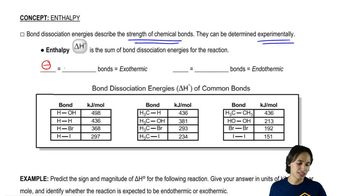
Bond dissociation energy is the energy required to break a specific bond in a molecule, resulting in the formation of free radicals. In the context of the proposed reaction, knowing the BDEs of C-I and C-H bonds is crucial for calculating the enthalpy changes (ΔH) for each step of the mechanism. This information helps predict the feasibility of the reaction and the energy changes associated with bond formation and cleavage.
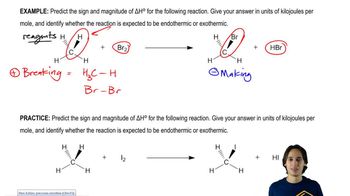
How to calculate enthalpy using bond dissociation energies.
Enthalpy Change (ΔH)
Enthalpy change (ΔH) is a measure of the heat absorbed or released during a chemical reaction at constant pressure. In this reaction, calculating ΔH for each step of the proposed mechanism allows for an understanding of the overall energy profile of the reaction. Mildly exothermic propagation steps indicate that the reaction is energetically favorable, which is essential for assessing the viability of iodination using tetraiodomethane as the iodine source.