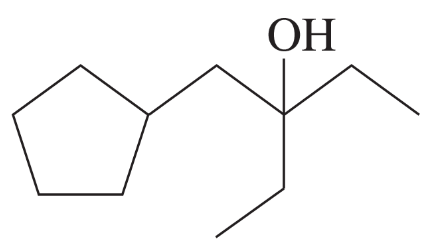
Often, compounds can be synthesized by more than one method. Show how this 3° alcohol can be made from the following: (a) two different ketones
Verified step by step guidance
1
Step 1: Identify the target molecule, which is a tertiary alcohol. A tertiary alcohol has the hydroxyl group (-OH) attached to a carbon atom that is connected to three other carbon atoms.
Step 2: Recognize that tertiary alcohols can be synthesized via the addition of a Grignard reagent to a ketone. The Grignard reagent provides the alkyl group, while the ketone provides the carbonyl group that is converted into the alcohol.
Step 3: For the first ketone synthesis, select a ketone where the carbonyl group is attached to the cyclohexane ring. React this ketone with a Grignard reagent containing the isopropyl group (CH(CH3)2). This reaction will yield the desired tertiary alcohol.
Step 4: For the second ketone synthesis, select a ketone where the carbonyl group is attached to the isopropyl group (CH(CH3)2). React this ketone with a Grignard reagent containing the cyclohexyl group (C6H11). This reaction will also yield the desired tertiary alcohol.
Step 5: Ensure that the reaction conditions are appropriate for Grignard reactions, such as anhydrous ether as the solvent, to prevent the Grignard reagent from reacting with water or other protic solvents.
Verified video answer for a similar problem:
This video solution was recommended by our tutors as helpful for the problem above
Video duration:
8m
Play a video:
0 Comments
Key Concepts
Here are the essential concepts you must grasp in order to answer the question correctly.
Alcohol Functional Group
An alcohol is an organic compound characterized by the presence of one or more hydroxyl (-OH) groups attached to a carbon atom. The properties and reactivity of alcohols are influenced by the structure of the carbon chain and the position of the hydroxyl group. In this case, the 3° alcohol shown has the hydroxyl group attached to a tertiary carbon, which is connected to three other carbon atoms.
Ketones are organic compounds containing a carbonyl group (C=O) flanked by two carbon atoms. They are versatile intermediates in organic synthesis and can undergo various reactions, such as nucleophilic addition. In the context of synthesizing the 3° alcohol, two different ketones can be used to provide the necessary carbon skeleton and functional groups through reactions like reduction or Grignard reactions.
Synthetic pathways refer to the series of chemical reactions and transformations used to convert starting materials into desired products. In organic chemistry, multiple synthetic routes can lead to the same compound, allowing chemists to choose the most efficient or practical method. Understanding these pathways is crucial for designing syntheses, especially when working with complex molecules like the 3° alcohol in the question.