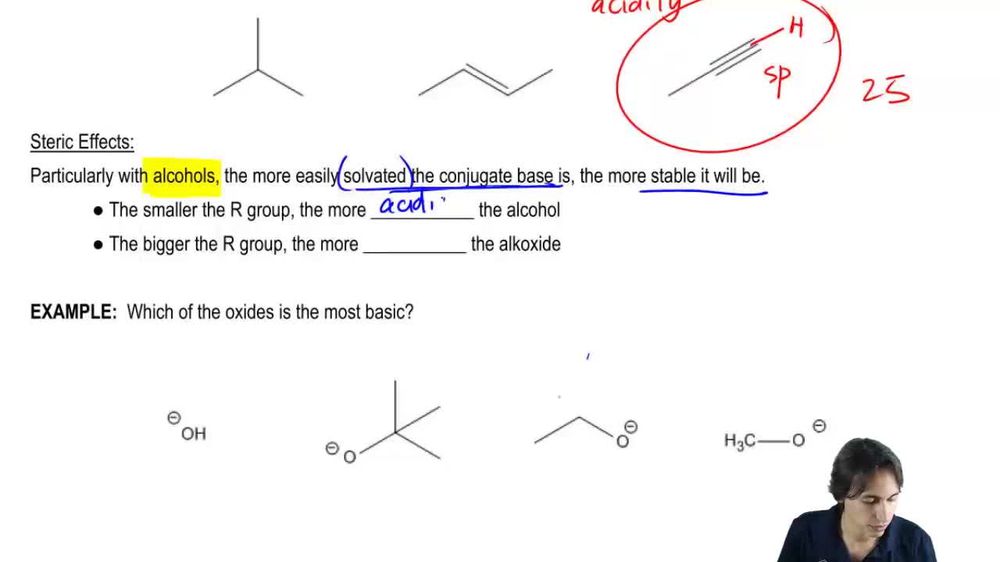
Explain why N,N,2,6-tetramethylaniline (shown) is a much stronger base than N,N-dimethylaniline.
Verified step by step guidance
1
Step 1: Begin by analyzing the structures of N,N,2,6-tetramethylaniline and N,N-dimethylaniline. Both molecules contain a nitrogen atom bonded to two methyl groups, but N,N,2,6-tetramethylaniline has additional methyl groups at the ortho positions (2 and 6) of the benzene ring.
Step 2: Understand the concept of basicity in amines. The basicity of an amine is determined by the availability of the lone pair of electrons on the nitrogen atom to accept a proton (H⁺). Factors that influence this availability include steric hindrance and electronic effects.
Step 3: Examine the steric effects in N,N,2,6-tetramethylaniline. The methyl groups at the ortho positions create steric hindrance, which prevents the nitrogen's lone pair from interacting effectively with the π-electrons of the benzene ring. This steric hindrance reduces conjugation between the nitrogen and the benzene ring, making the lone pair more available for protonation.
Step 4: Compare this to N,N-dimethylaniline. In this molecule, there are no ortho substituents, so the nitrogen's lone pair can delocalize into the benzene ring through resonance. This delocalization reduces the availability of the lone pair for protonation, making N,N-dimethylaniline a weaker base.
Step 5: Conclude that the steric hindrance caused by the ortho methyl groups in N,N,2,6-tetramethylaniline prevents resonance delocalization of the nitrogen's lone pair, increasing its basicity compared to N,N-dimethylaniline.
Verified video answer for a similar problem:
This video solution was recommended by our tutors as helpful for the problem above
Video duration:
7m
Play a video:
0 Comments
Key Concepts
Here are the essential concepts you must grasp in order to answer the question correctly.
Basicity in Organic Chemistry
Basicity refers to the ability of a compound to accept protons (H+ ions). In organic chemistry, the strength of a base is influenced by the availability of its lone pair of electrons to bond with protons. Stronger bases have more available electron density, which allows them to more readily accept protons.
Steric hindrance occurs when the spatial arrangement of atoms in a molecule prevents certain interactions, such as protonation. In the case of N,N,2,6-tetramethylaniline, the presence of bulky methyl groups at the 2 and 6 positions creates a more favorable environment for the nitrogen's lone pair to interact with protons, enhancing its basicity compared to N,N-dimethylaniline, which has less steric bulk.
Electron-donating groups, such as alkyl groups, increase the electron density on the nitrogen atom in amines, enhancing their basicity. In N,N,2,6-tetramethylaniline, the four methyl groups significantly increase the electron density on the nitrogen, making it a stronger base than N,N-dimethylaniline, which has only two methyl groups contributing to electron donation.

 7:18 minutes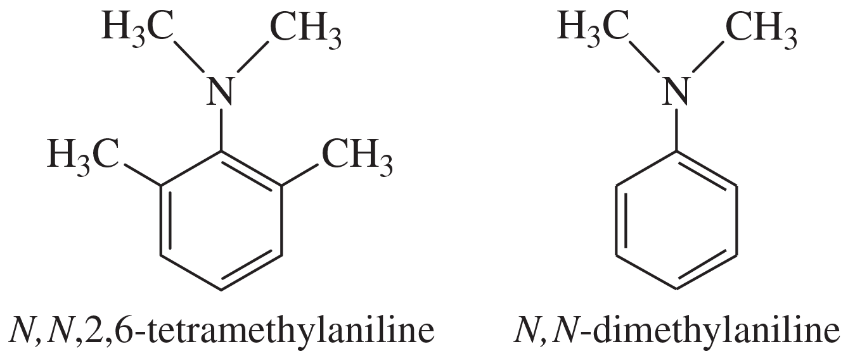
 Verified step by step guidance
 00:56
00:56