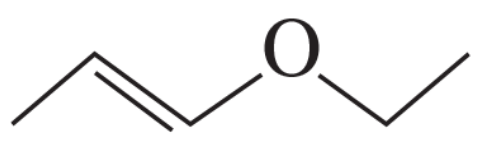
What are the major products obtained when the following ether is heated with one equivalent of HI?
Verified step by step guidance
1
Step 1: Analyze the structure of the ether provided. The ether consists of an oxygen atom bonded to two alkyl groups: ethyl (CH₃CH₂-) and isopropyl (CH₃CH(CH₃)-).
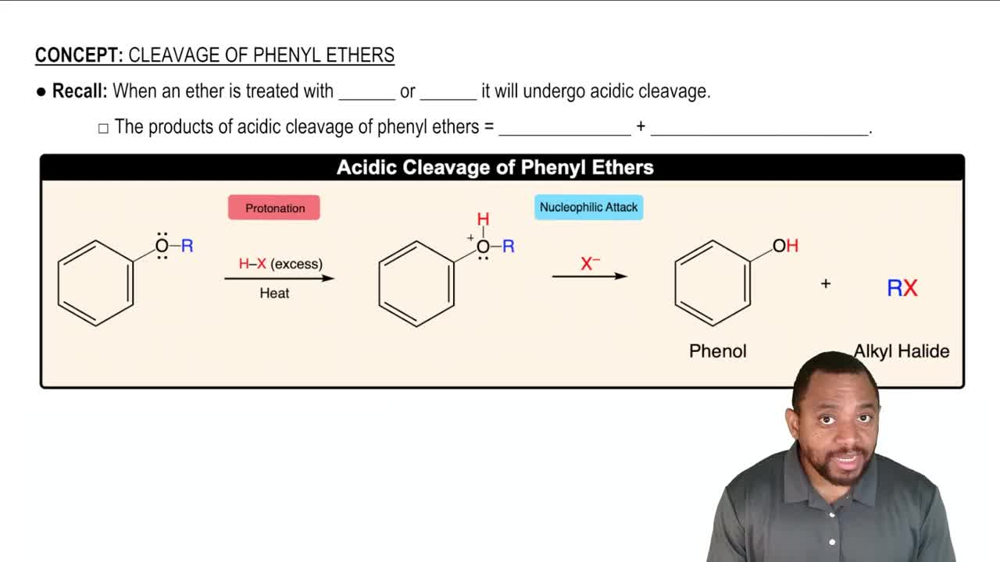
Step 2: Understand the reaction mechanism. When an ether is heated with one equivalent of HI, the bond between the oxygen and one of the alkyl groups is cleaved. The cleavage occurs via an SN2 mechanism if the alkyl group is primary or secondary, and via an SN1 mechanism if the alkyl group is tertiary.
Step 3: Determine which bond will break. In this case, the ethyl group is primary, and the isopropyl group is secondary. The bond between the oxygen and the ethyl group is more likely to break due to the SN2 mechanism being favored for primary alkyl groups.
Step 4: Predict the products. The cleavage of the ether will result in the formation of two products: ethyl iodide (CH₃CH₂I) and isopropanol (CH₃CH(CH₃)OH). The ethyl group reacts with the iodide ion (I⁻), while the isopropyl group retains the hydroxyl group (OH).
Step 5: Summarize the reaction. Heating the ether with one equivalent of HI results in the major products ethyl iodide and isopropanol, formed through the cleavage of the ether bond.
Verified video answer for a similar problem:
This video solution was recommended by our tutors as helpful for the problem above
Video duration:
2m
Play a video:
0 Comments
Key Concepts
Here are the essential concepts you must grasp in order to answer the question correctly.
Ethers and Their Reactions
Ethers are organic compounds characterized by an oxygen atom connected to two alkyl or aryl groups. When heated with strong acids like HI, ethers undergo cleavage, breaking the C-O bond. This reaction typically results in the formation of alcohols and alkyl halides, depending on the structure of the ether and the conditions of the reaction.
Hydroiodic acid is a strong acid that can protonate ethers, making them more susceptible to nucleophilic attack. In the presence of HI, the ether is cleaved to yield iodide ions and alcohols. The reactivity of HI facilitates the breaking of the ether bond, leading to the formation of the corresponding alkyl iodide and alcohol.
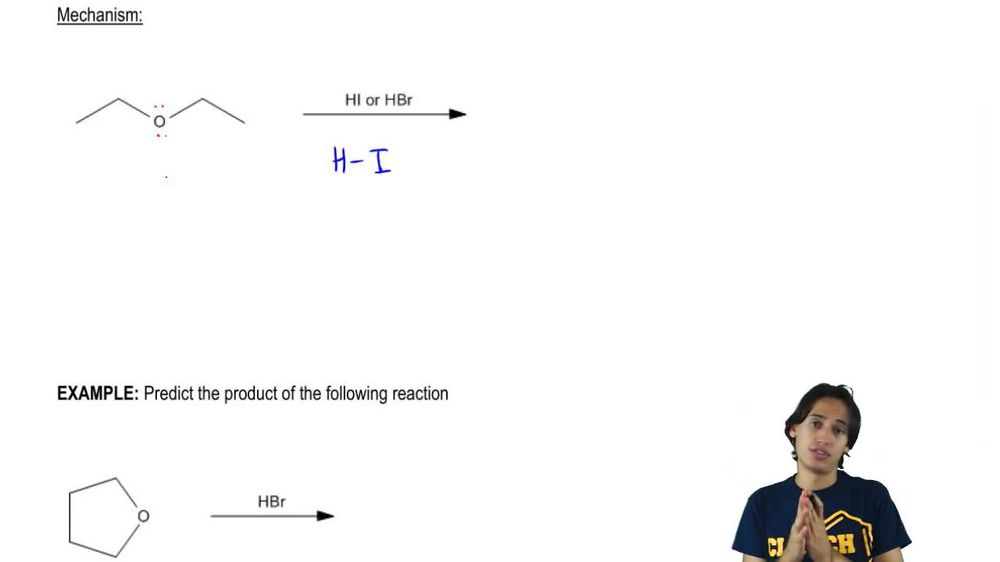
The mechanism of ether cleavage involves protonation of the ether oxygen, followed by nucleophilic attack by iodide ions. This results in the formation of an alkyl iodide and an alcohol. Understanding this mechanism is crucial for predicting the products of the reaction, as the structure of the ether influences the pathway and the major products formed.