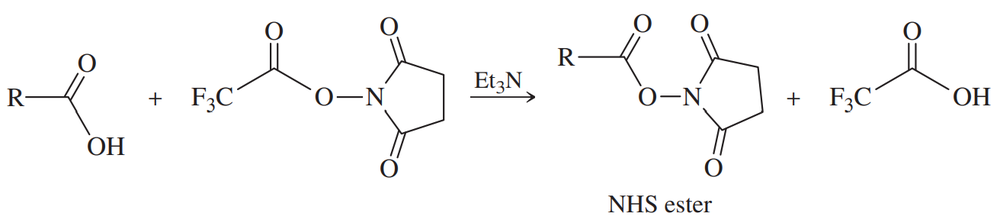
There are many methods for activating a carboxylic acid in preparation for coupling with an amine. The following method converts the acid to an N-hydroxysuccinimide (NHS) ester. (c) Propose a mechanism for the reaction of the NHS ester with an amine, R–NH2.
Verified step by step guidance
1
Step 1: Recognize the functional groups involved in the reaction. The NHS ester contains an activated ester group, which is highly reactive toward nucleophiles like amines due to the electron-withdrawing properties of the succinimide ring.
Step 2: Identify the nucleophile in the reaction. The amine (R-NH2) acts as the nucleophile, attacking the carbonyl carbon of the NHS ester. This occurs because the carbonyl carbon is electrophilic, making it susceptible to nucleophilic attack.
Step 3: Propose the first step of the mechanism. The lone pair of electrons on the nitrogen atom of the amine attacks the carbonyl carbon of the NHS ester, forming a tetrahedral intermediate. This intermediate is stabilized by the resonance of the succinimide ring.
Step 4: Describe the collapse of the tetrahedral intermediate. The intermediate undergoes rearrangement, leading to the expulsion of the N-hydroxysuccinimide (NHS) group as a leaving group. This step regenerates the carbonyl group and forms the amide bond between the carboxylic acid derivative and the amine.
Step 5: Conclude the reaction. The final product is an amide (R-CONH-R') formed from the coupling of the NHS ester and the amine, along with the release of NHS as a byproduct. This reaction is efficient due to the excellent leaving group properties of NHS.
Verified video answer for a similar problem:
This video solution was recommended by our tutors as helpful for the problem above
Video duration:
5m
Play a video:
0 Comments
Key Concepts
Here are the essential concepts you must grasp in order to answer the question correctly.
Carboxylic Acid Derivatives
Carboxylic acids can form various derivatives, such as esters and amides, which are more reactive than the parent acid. The conversion of a carboxylic acid to an N-hydroxysuccinimide (NHS) ester is a common method to enhance its reactivity towards nucleophiles, like amines. Understanding these derivatives is crucial for predicting reaction mechanisms and outcomes.
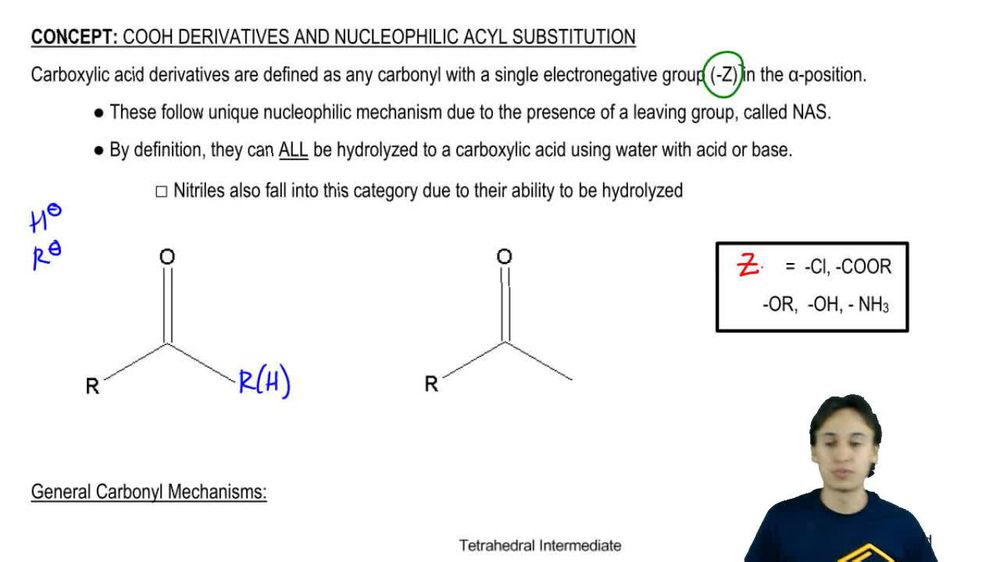
Nucleophilic acyl substitution is a fundamental reaction mechanism in organic chemistry where a nucleophile attacks the carbonyl carbon of an acyl compound, leading to the replacement of a leaving group. In the case of the NHS ester reacting with an amine, the amine acts as the nucleophile, attacking the carbonyl carbon and forming a new amide bond while releasing NHS as a leaving group.
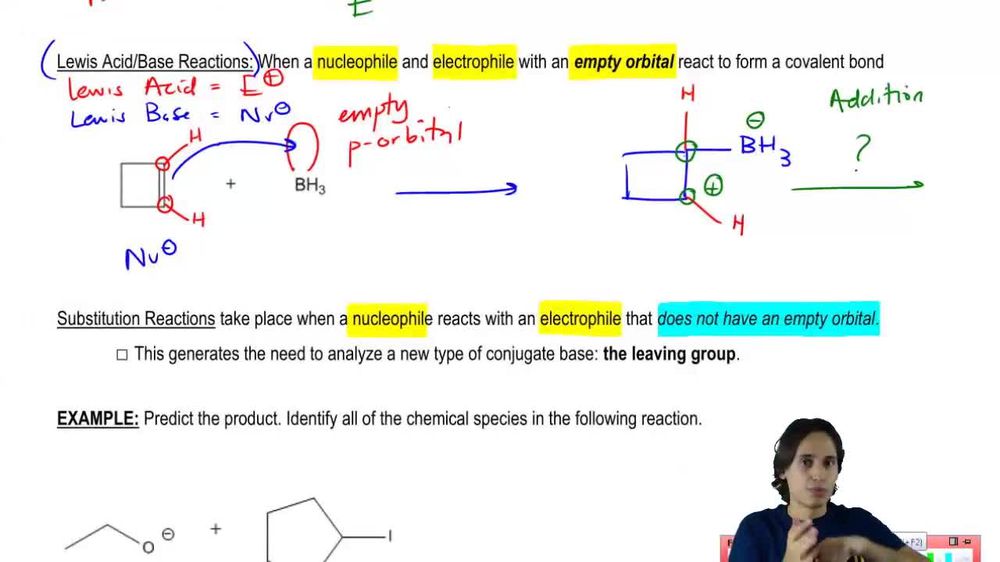
Nucleophiles and Electrophiles can react in Substitution Reactions.
Mechanism of Amine Reactions
The mechanism of amine reactions involves the formation of a tetrahedral intermediate when the amine nucleophile attacks the carbonyl carbon. This intermediate can then collapse, leading to the formation of a new bond and the expulsion of a leaving group. Understanding this mechanism is essential for predicting the products and the steps involved in the reaction of NHS esters with amines.