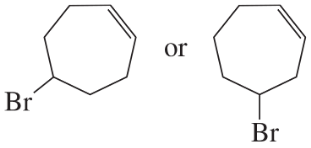
Which alkyl halide in each pair is more reactive in an E2 reaction with hydroxide ion? a. b.
Verified step by step guidance
1
Step 1: Understand the E2 reaction mechanism. E2 reactions are bimolecular elimination reactions where a base (such as hydroxide ion) removes a proton from a β-carbon, and a leaving group (such as bromine) departs from the α-carbon, forming a double bond.
Step 2: Analyze the first pair of alkyl halides. The first structure has bromine attached to a secondary carbon, while the second structure has bromine attached to a tertiary carbon. In E2 reactions, tertiary alkyl halides are generally more reactive due to the stability of the transition state and the ability to form a more substituted alkene.
Step 3: Analyze the second pair of alkyl halides. The first structure has bromine attached to a carbon adjacent to a double bond (allylic position), while the second structure has bromine attached to a carbon that is not adjacent to a double bond. Allylic halides are more reactive in E2 reactions because the resulting double bond can be stabilized by resonance.
Step 4: Consider steric hindrance and base accessibility. In the first pair, the tertiary alkyl halide may have slightly more steric hindrance, but this is outweighed by the increased reactivity due to the formation of a more substituted alkene. In the second pair, the allylic halide is favored due to resonance stabilization.
Step 5: Conclude that for the first pair, the tertiary alkyl halide is more reactive in an E2 reaction. For the second pair, the allylic halide is more reactive in an E2 reaction due to resonance stabilization of the product.
Verified video answer for a similar problem:
This video solution was recommended by our tutors as helpful for the problem above
Video duration:
5m
Play a video:
0 Comments
Key Concepts
Here are the essential concepts you must grasp in order to answer the question correctly.
E2 Reaction Mechanism
The E2 (bimolecular elimination) reaction is a concerted process where a base removes a proton from a β-carbon while a leaving group departs from the α-carbon, resulting in the formation of a double bond. The reaction rate depends on the concentration of both the alkyl halide and the base, making it a second-order reaction. Understanding the mechanism is crucial for predicting which alkyl halide will react more readily.
The structure of alkyl halides significantly influences their reactivity in E2 reactions. Steric hindrance, which arises from bulky groups around the reactive site, can impede the approach of the base. Generally, tertiary alkyl halides are more reactive than secondary, and primary halides are the least reactive due to their steric and electronic environments.
The strength of the base used in an E2 reaction plays a critical role in determining the reaction's rate and outcome. Strong bases, such as hydroxide ions, are more effective at abstracting protons, facilitating the elimination process. The choice of base can also influence the regioselectivity of the reaction, making it essential to consider when evaluating the reactivity of different alkyl halides.

 5:18 minutes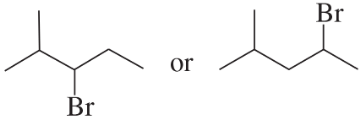
 Verified step by step guidance

 09:36
09:36