Show how you would add a Grignard reagent to an ester or a nitrile to synthesize (a) 4-phenylheptan-4-ol.
Verified step by step guidance
1
Step 1: Understand the target molecule. The target molecule, 4-phenylheptan-4-ol, is a tertiary alcohol with a phenyl group attached to the fourth carbon. This suggests that a Grignard reagent will react with a carbonyl compound to form the alcohol.
Step 2: Choose the starting material. To synthesize a tertiary alcohol, a Grignard reagent must react with either an ester or a nitrile. In this case, an ester is a suitable choice because it allows for the addition of two alkyl groups from the Grignard reagent.
Step 3: Select the Grignard reagent. The Grignard reagent should provide the phenyl group (C₆H₅) and the appropriate alkyl chain to form the desired product. Use phenylmagnesium bromide (C₆H₅MgBr) as the Grignard reagent.
Step 4: React the ester with the Grignard reagent. The ester (e.g., ethyl butanoate, CH₃CH₂CH₂COOCH₂CH₃) will undergo nucleophilic attack by the Grignard reagent. The first equivalent of the Grignard reagent will form a ketone intermediate, and the second equivalent will react with the ketone to form the tertiary alcohol.
Step 5: Perform the workup. After the reaction is complete, add water or dilute acid to protonate the alkoxide intermediate and isolate the final product, 4-phenylheptan-4-ol.
Verified video answer for a similar problem:
This video solution was recommended by our tutors as helpful for the problem above
Video duration:
3m
Play a video:
0 Comments
Key Concepts
Here are the essential concepts you must grasp in order to answer the question correctly.
Grignard Reagents
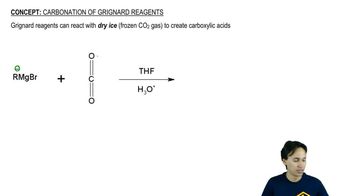
Grignard reagents are organomagnesium compounds that act as nucleophiles in organic reactions. They are formed by reacting alkyl or aryl halides with magnesium metal in dry ether. These reagents can react with carbonyl compounds, such as esters and nitriles, to form alcohols after hydrolysis. Understanding their reactivity is crucial for synthesizing complex organic molecules.
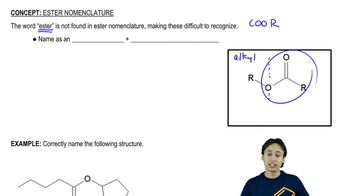
Esters are functional groups characterized by a carbonyl (C=O) adjacent to an ether (C-O) group. They can undergo nucleophilic addition reactions, where a Grignard reagent attacks the carbonyl carbon, leading to the formation of a tetrahedral intermediate. This intermediate can then be protonated to yield an alcohol. Recognizing how esters react with Grignard reagents is essential for the synthesis of alcohols like 4-phenylheptan-4-ol.
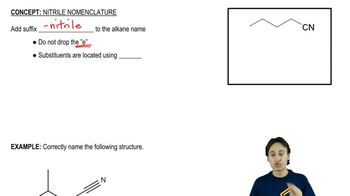
Nitriles contain a carbon triple-bonded to a nitrogen atom and can also react with Grignard reagents. The nucleophilic attack by the Grignard reagent on the carbon of the nitrile leads to the formation of an intermediate that can be hydrolyzed to yield an amine or an alcohol. This reactivity is important for constructing carbon skeletons in organic synthesis, particularly when aiming for specific alcohols.