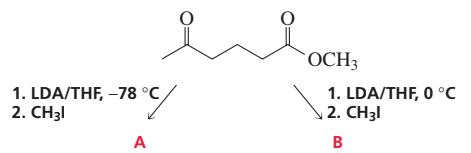
Alkylation of the following compound with methyl iodide under two different conditions forms two different ketoesters (A and B). Each ketoester forms a cyclic diketone (C and D) when treated with methoxide ion in methanol. a. Draw the structures of A and B, and indicate the conditions used in the alkylation reaction that cause that ketoester to be formed.
Verified step by step guidance
1
Step 1: Analyze the given compound and reaction conditions. The compound contains two carbonyl groups (a ketone and an ester), which are capable of undergoing enolate formation. The alkylation reaction involves methyl iodide (CH₃I) as the alkylating agent, and the enolate formation is controlled by the use of LDA (lithium diisopropylamide) in THF (tetrahydrofuran) at different temperatures.
Step 2: Understand the role of temperature in enolate formation. At -78°C, LDA selectively deprotonates the less sterically hindered alpha-carbon (kinetic enolate formation). At 0°C, LDA allows for equilibration, favoring the more stable enolate (thermodynamic enolate formation). This difference in enolate formation leads to the formation of two different ketoesters (A and B).
Step 3: For the reaction at -78°C (kinetic conditions), identify the alpha-carbon that is less sterically hindered. Deprotonation at this site forms the kinetic enolate, which reacts with methyl iodide to form ketoester A. Draw the structure of ketoester A, showing the methyl group added to the less hindered alpha-carbon.
Step 4: For the reaction at 0°C (thermodynamic conditions), identify the alpha-carbon that forms the more stable enolate. Deprotonation at this site forms the thermodynamic enolate, which reacts with methyl iodide to form ketoester B. Draw the structure of ketoester B, showing the methyl group added to the more stable alpha-carbon.
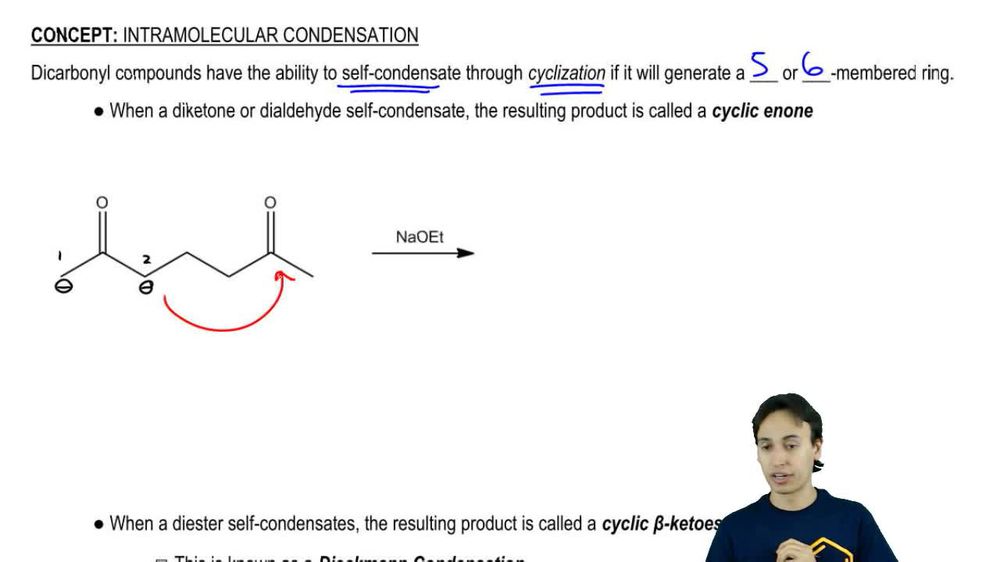
Step 5: When treated with methoxide ion in methanol, both ketoesters (A and B) undergo intramolecular aldol condensation to form cyclic diketones (C and D). Draw the structures of C and D, showing the cyclization and formation of the diketone products.
Verified video answer for a similar problem:
This video solution was recommended by our tutors as helpful for the problem above
Video duration:
7m
Play a video:
0 Comments
Key Concepts
Here are the essential concepts you must grasp in order to answer the question correctly.
Alkylation Reaction
Alkylation is a chemical reaction that involves the transfer of an alkyl group from one molecule to another. In this context, the alkylation of a compound with methyl iodide (CH3I) occurs under different conditions, leading to the formation of distinct ketoesters. The choice of conditions, such as temperature and the base used, significantly influences the regioselectivity and outcome of the reaction.
LDA is a strong, non-nucleophilic base commonly used in organic synthesis to deprotonate compounds, generating enolates. The temperature at which LDA is used affects the stability and reactivity of the enolate formed. For instance, using LDA at -78°C leads to the formation of a more stable enolate, which can result in different alkylation products compared to using LDA at 0°C.
Cyclic diketones are formed through the reaction of ketoesters with methoxide ions in methanol. This process typically involves nucleophilic attack by the methoxide on the carbonyl carbon of the ketoester, leading to the formation of a cyclic structure. The specific ketoester formed in the initial alkylation step determines the structure of the resulting cyclic diketone, highlighting the importance of the alkylation conditions.