For each pair of compounds, circle the compound you expect to have the higher boiling point. Explain your reasoning. a. (CH3)3C—C(CH3)3 or (CH3)2CH—CH2CH2—CH(CH3)2 b. CH3(CH2)6CH3 or CH3(CH2)5CH2OH c. CH3CH2OCH2CH3 or CH3CH2CH2CH2OH
Verified step by step guidance
1
Step 1: Understand the factors affecting boiling points. Boiling points are influenced by molecular weight, intermolecular forces (such as hydrogen bonding, dipole-dipole interactions, and London dispersion forces), and molecular structure (branching vs. linear).
Step 2: Analyze compound pair (a): (CH3)3C—C(CH3)3 vs. (CH3)2CH—CH2CH2—CH(CH3)2. Both are hydrocarbons, but the first compound is more branched. Branching generally reduces boiling points due to decreased surface area and weaker London dispersion forces. Therefore, the less branched compound is likely to have a higher boiling point.
Step 3: Analyze compound pair (b): CH3(CH2)6CH3 vs. CH3(CH2)5CH2OH. The second compound contains an alcohol group (-OH), which can form hydrogen bonds, significantly increasing its boiling point compared to the first compound, which is a simple alkane.
Step 4: Analyze compound pair (c): CH3CH2OCH2CH3 vs. CH3CH2CH2CH2OH. The second compound is an alcohol, capable of hydrogen bonding, whereas the first is an ether, which cannot form hydrogen bonds as effectively. Hydrogen bonding in alcohols leads to higher boiling points.
Step 5: Summarize the reasoning: For each pair, consider the presence of functional groups capable of hydrogen bonding and the degree of branching. Compounds with hydrogen bonding capabilities or less branching typically have higher boiling points.
Verified video answer for a similar problem:
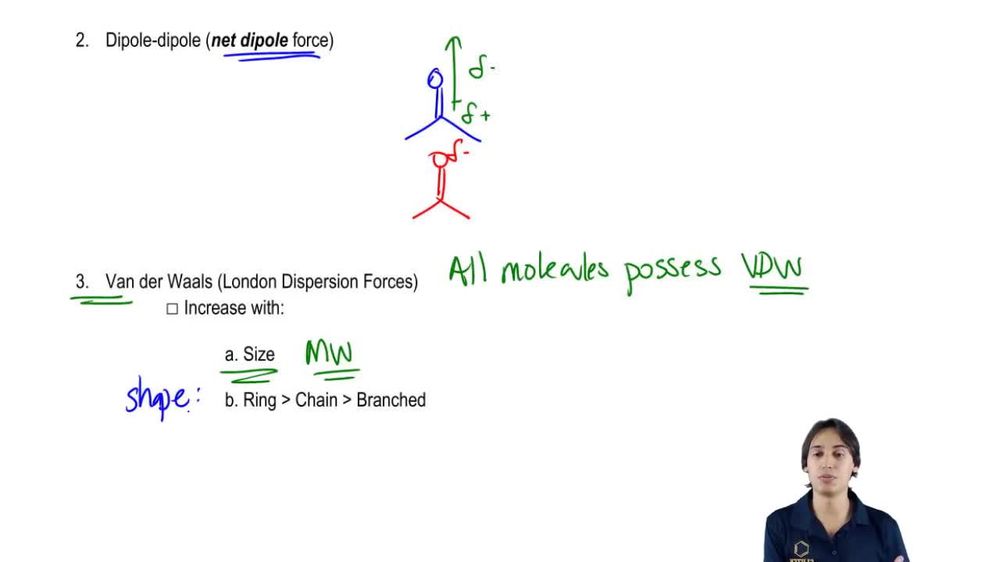
This video solution was recommended by our tutors as helpful for the problem above
Video duration:
4m
Play a video:
0 Comments
Key Concepts
Here are the essential concepts you must grasp in order to answer the question correctly.
Intermolecular Forces
Intermolecular forces, including hydrogen bonding, dipole-dipole interactions, and London dispersion forces, significantly influence boiling points. Compounds with stronger intermolecular forces generally have higher boiling points. For example, hydrogen bonding, present in alcohols, is stronger than the dispersion forces in alkanes, leading to higher boiling points.
The structure and branching of a molecule affect its boiling point. Linear molecules can pack closely together, increasing intermolecular forces, while branched molecules have less surface area contact, reducing these forces. Thus, linear alkanes typically have higher boiling points than their branched counterparts due to increased van der Waals interactions.
Functional groups in organic compounds determine the type and strength of intermolecular forces. Alcohols, with hydroxyl groups, can form hydrogen bonds, leading to higher boiling points compared to ethers or alkanes, which primarily exhibit weaker dispersion forces. The presence of polar functional groups enhances intermolecular attractions, raising boiling points.