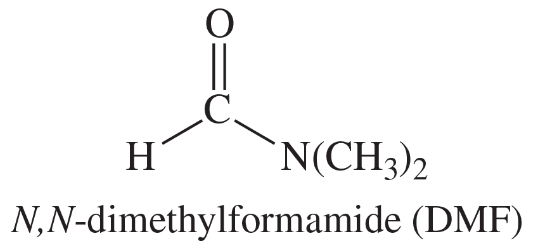
Show how to synthesize the following compounds, using appropriate carboxylic acids and amines. (c)
Verified step by step guidance
1
Step 1: Identify the target compound, N,N-dimethylformamide (DMF). It is an amide with a formyl group (H-C=O) attached to a nitrogen atom that is substituted with two methyl groups.
Step 2: Recognize the starting materials needed for synthesis. To form an amide, you need a carboxylic acid and an amine. In this case, the carboxylic acid should be formic acid (HCOOH), and the amine should be dimethylamine ((CH₃)₂NH).
Step 3: Understand the reaction mechanism. The carboxylic acid reacts with the amine in the presence of a dehydrating agent (such as DCC or heat) to form the amide bond. This involves the removal of water (H₂O) during the reaction.
Step 4: Write the chemical equation for the synthesis: HCOOH + (CH₃)₂NH → HCON(CH₃)₂ + H₂O. This shows the formation of DMF and water as a byproduct.
Step 5: Ensure proper reaction conditions. Use a dehydrating agent or heat to drive the reaction forward and facilitate the formation of the amide bond. Monitor the reaction to ensure completion and purity of the product.
Verified video answer for a similar problem:
This video solution was recommended by our tutors as helpful for the problem above
Video duration:
4m
Play a video:
0 Comments
Key Concepts
Here are the essential concepts you must grasp in order to answer the question correctly.
Carboxylic Acids
Carboxylic acids are organic compounds characterized by the presence of a carboxyl group (-COOH). They are important in organic synthesis as they can react with amines to form amides. Understanding the reactivity and properties of carboxylic acids is crucial for synthesizing compounds like N,N-dimethylformamide (DMF), which involves the conversion of a carboxylic acid into an amide.
Amines are organic compounds derived from ammonia by replacing one or more hydrogen atoms with alkyl or aryl groups. They play a significant role in organic synthesis, particularly in the formation of amides from carboxylic acids. In the case of DMF, dimethylamine is the amine used, highlighting the importance of understanding the structure and reactivity of different amines in synthesis.
Amide formation is a key reaction in organic chemistry where a carboxylic acid reacts with an amine to produce an amide and water. This reaction is typically facilitated by heat or the presence of a coupling agent. For synthesizing DMF, the reaction between formic acid and dimethylamine exemplifies this process, showcasing the transformation of functional groups and the importance of understanding reaction mechanisms.