Draw the condensed structure for each of the following: d. vinyl bromide e. 1,2-dimethylcyclopentene f. diallylamine
Verified step by step guidance
1
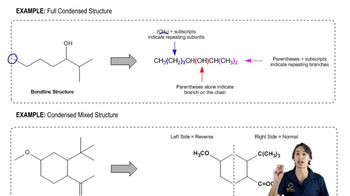
Step 1: Understand the term 'condensed structure'. A condensed structure is a way of writing a chemical formula that shows the connectivity of atoms in a molecule without explicitly drawing bonds. It is compact and often used for organic molecules.
Step 2: For vinyl bromide (d), recognize that 'vinyl' refers to the CH₂=CH- group, which is an alkene functional group. Bromide indicates the presence of a bromine atom attached to the vinyl group. Combine these to form the condensed structure: CH₂=CHBr.
Step 3: For 1,2-dimethylcyclopentene (e), identify the cyclopentene ring, which is a five-membered ring containing one double bond. The '1,2-dimethyl' indicates two methyl groups (-CH₃) attached to the first and second carbons of the ring. Place the double bond and methyl groups appropriately to write the condensed structure.
Step 4: For diallylamine (f), recognize that 'allyl' refers to the CH₂=CH-CH₂- group, and 'diallyl' means there are two allyl groups. 'Amine' indicates the presence of a nitrogen atom. Attach the two allyl groups to the nitrogen atom to form the condensed structure: NH(CH₂CH=CH₂)₂.
Step 5: Double-check each condensed structure to ensure it accurately represents the connectivity and functional groups described in the problem. Verify that the structures are consistent with IUPAC naming conventions.
Verified video answer for a similar problem:
This video solution was recommended by our tutors as helpful for the problem above
Video duration:
9m
Play a video:
0 Comments
Key Concepts
Here are the essential concepts you must grasp in order to answer the question correctly.
Condensed Structural Formula
A condensed structural formula is a way of representing a chemical compound that shows the arrangement of atoms and the connectivity between them without depicting all the bonds explicitly. It typically groups atoms together to indicate how they are bonded, making it easier to visualize the structure of organic molecules. For example, in vinyl bromide, the formula can be written as CH2=CHBr, indicating the presence of a double bond and a bromine atom.
Cycloalkenes are a class of cyclic hydrocarbons that contain at least one carbon-carbon double bond within the ring structure. They are characterized by their unique ring formation, which can influence their reactivity and stability. In the case of 1,2-dimethylcyclopentene, the '1,2' indicates the positions of the methyl groups on the cyclopentene ring, which is crucial for understanding its chemical properties and potential reactions.
Amines are organic compounds derived from ammonia (NH3) by replacing one or more hydrogen atoms with alkyl or aryl groups. They can be classified as primary, secondary, or tertiary based on the number of carbon-containing groups attached to the nitrogen atom. Diallylamine, for instance, is a primary amine with two allyl groups attached to the nitrogen, which affects its reactivity and applications in organic synthesis.