When alkynes are treated with water and bromine a bromoketone is produced. Provide a plausible arrow-pushing mechanism that accounts for the formation of this product.
Verified step by step guidance
1
Identify the starting material (alkyne) and the reagents (water and bromine). Recognize that the reaction involves electrophilic addition followed by nucleophilic attack and tautomerization.
In the first step, bromine (Br₂) acts as an electrophile. The π-electrons of the alkyne attack one bromine atom, forming a bromonium ion intermediate. This step involves the breaking of the Br-Br bond, leaving a bromide ion (Br⁻) as a byproduct.
Next, water (H₂O) acts as a nucleophile and attacks the more substituted carbon of the bromonium ion, opening the three-membered ring. This step results in the formation of a bromohydrin intermediate.
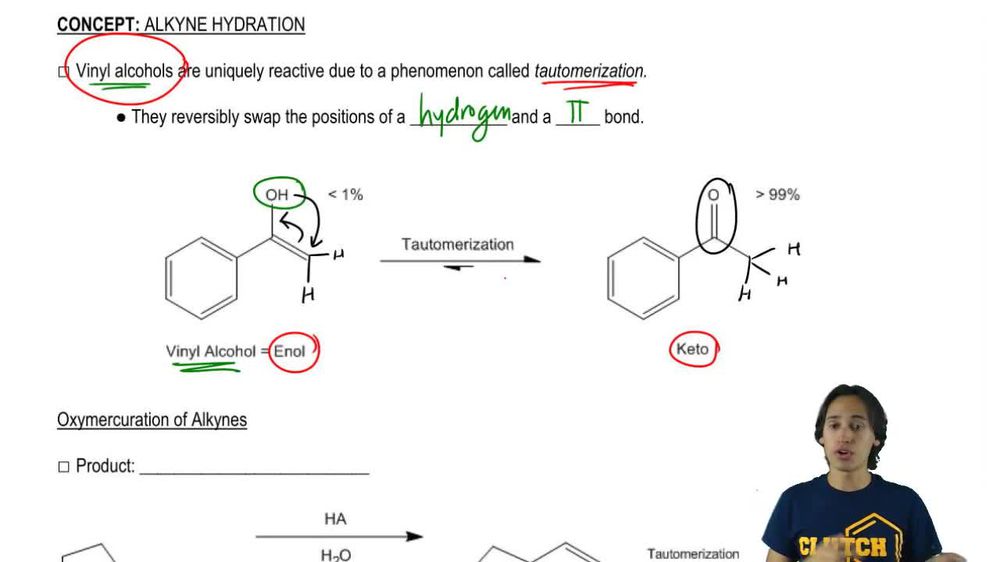
The bromohydrin undergoes tautomerization. The hydroxyl group (-OH) is protonated by a proton donor (e.g., H⁺), forming a good leaving group (H₂O). The adjacent carbon-carbon bond electrons shift to form a double bond, and the bromide ion (Br⁻) abstracts a proton from the neighboring carbon, resulting in the formation of a bromoketone.
Finally, confirm the product structure as a bromoketone, where the carbonyl group (C=O) is adjacent to a bromine atom. This product is stabilized due to resonance and the electron-withdrawing effect of bromine.
Verified video answer for a similar problem:
This video solution was recommended by our tutors as helpful for the problem above
Video duration:
4m
Play a video:
0 Comments
Key Concepts
Here are the essential concepts you must grasp in order to answer the question correctly.
Alkynes and Their Reactivity
Alkynes are hydrocarbons containing at least one carbon-carbon triple bond. Their reactivity is significantly influenced by this triple bond, which can undergo various reactions, including electrophilic addition. Understanding the nature of alkynes is crucial for predicting how they will interact with reagents like water and bromine.
Electrophilic addition is a fundamental reaction mechanism in organic chemistry where an electrophile reacts with a nucleophile, leading to the formation of a more stable product. In the case of alkynes, the triple bond acts as a nucleophile, attacking the electrophilic bromine, which initiates the mechanism that ultimately leads to the formation of a bromoketone.
Arrow-pushing notation is a visual representation used to depict the movement of electrons during chemical reactions. It illustrates how electrons are transferred between atoms and bonds, helping to clarify the steps in a reaction mechanism. Mastery of this notation is essential for accurately conveying the sequence of events in the formation of products like bromoketones from alkynes.