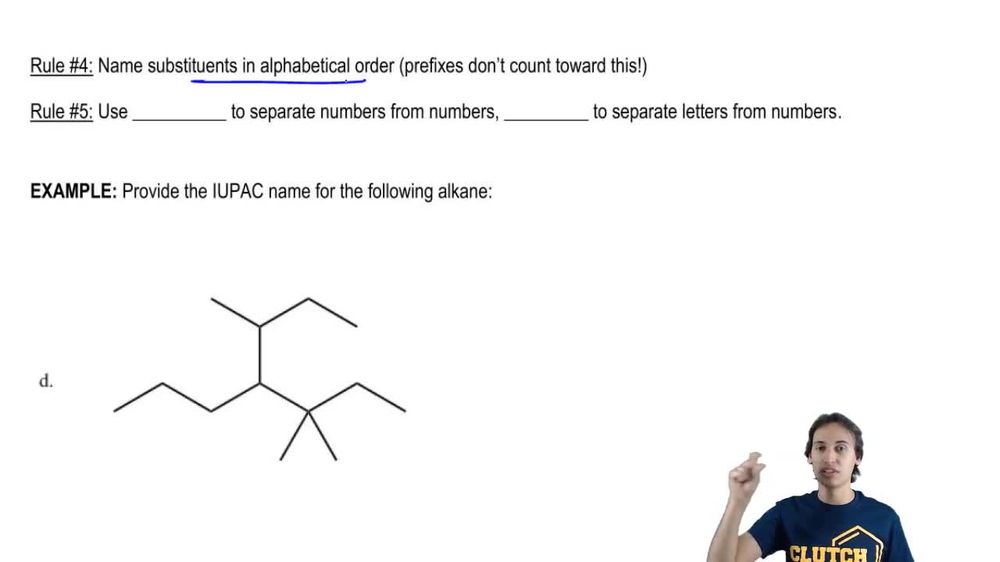
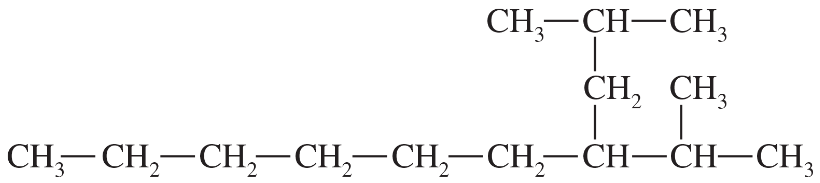
Name the following alkanes and haloalkanes. When two or more substituents are present, list them in alphabetical order. (c) (d)
Verified step by step guidance
1
Step 1: Identify the longest continuous carbon chain in the molecule. This will determine the base name of the alkane.
Step 2: Number the carbon atoms in the longest chain starting from the end nearest to the first substituent. This ensures the lowest possible numbers for the substituents.
Step 3: Identify and name each substituent attached to the main carbon chain. Substituents can be alkyl groups or halogens.
Step 4: List the substituents in alphabetical order, ignoring any numerical prefixes like 'di-', 'tri-', etc., when determining the order.
Step 5: Combine the names of the substituents with the base name of the alkane, using the numbers to indicate the position of each substituent on the carbon chain. Use hyphens to separate numbers from words and commas to separate numbers.
Verified video answer for a similar problem:
This video solution was recommended by our tutors as helpful for the problem above
Video duration:
4m
Play a video:
0 Comments
Key Concepts
Here are the essential concepts you must grasp in order to answer the question correctly.
IUPAC Nomenclature for Alkanes
The IUPAC nomenclature system provides a standardized way to name organic compounds. For alkanes, the longest continuous carbon chain is identified as the parent chain, and its name is based on the number of carbon atoms it contains. Substituents attached to the parent chain are named as prefixes, and their positions are indicated by numbers, ensuring the lowest possible numbers for substituents.
Haloalkanes are alkanes that contain one or more halogen atoms (such as fluorine, chlorine, bromine, or iodine) as substituents. In naming haloalkanes, the halogen substituents are treated as prefixes (e.g., fluoro-, chloro-, bromo-, iodo-) and are listed in alphabetical order along with other substituents. The position of each halogen is indicated by a number corresponding to its attachment point on the carbon chain.
When naming compounds with multiple substituents, the substituents are listed in alphabetical order in the compound's name. This rule applies regardless of the nature of the substituents, whether they are alkyl groups or halogens. The prefixes such as di-, tri-, etc., used to indicate multiple identical substituents, are not considered in the alphabetical ordering.

 4:59 minutes
 Verified step by step guidance
 02:47
02:47