Rank the following alkyl bromides from most reactive to least reactive in an SN2 reaction: 1-bromo-2-methylbutane, 1-bromo-3-methylbutane, 2-bromo-2-methylbutane, and 1-bromopentane.
Verified step by step guidance
1
Step 1: Recall the key factors that influence the rate of an SN2 reaction. The SN2 mechanism involves a single-step nucleophilic substitution where the nucleophile attacks the electrophilic carbon and displaces the leaving group. The rate of the reaction is highly dependent on steric hindrance around the electrophilic carbon. Less steric hindrance leads to faster reactions.
Step 2: Analyze the structure of each alkyl bromide. For 1-bromo-2-methylbutane, the bromine is attached to a primary carbon, but there is steric hindrance from the adjacent methyl group. For 1-bromo-3-methylbutane, the bromine is attached to a primary carbon with less steric hindrance compared to 1-bromo-2-methylbutane. For 2-bromo-2-methylbutane, the bromine is attached to a tertiary carbon, which has significant steric hindrance. For 1-bromopentane, the bromine is attached to a primary carbon with no adjacent bulky groups, making it the least hindered.
Step 3: Rank the alkyl bromides based on steric hindrance. The least hindered compound will be the most reactive in an SN2 reaction, while the most hindered compound will be the least reactive. Based on the analysis, 1-bromopentane has the least steric hindrance, followed by 1-bromo-3-methylbutane, then 1-bromo-2-methylbutane, and finally 2-bromo-2-methylbutane.
Step 4: Consider the leaving group (bromine) in all compounds. Bromine is a good leaving group, so the reactivity differences are primarily determined by steric factors rather than the leaving group itself.
Step 5: Finalize the ranking based on steric hindrance and SN2 reactivity. The order from most reactive to least reactive is: 1-bromopentane > 1-bromo-3-methylbutane > 1-bromo-2-methylbutane > 2-bromo-2-methylbutane.
Verified video answer for a similar problem:
This video solution was recommended by our tutors as helpful for the problem above
Video duration:
6m
Play a video:
0 Comments
Key Concepts
Here are the essential concepts you must grasp in order to answer the question correctly.
SN2 Mechanism
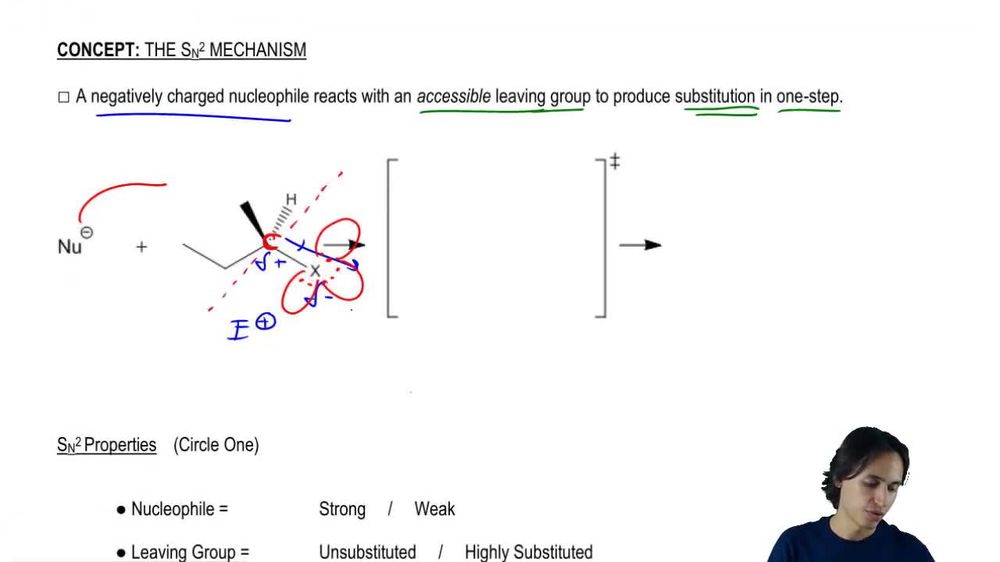
The SN2 (substitution nucleophilic bimolecular) mechanism involves a single concerted step where a nucleophile attacks the electrophilic carbon, displacing a leaving group. This reaction is characterized by a backside attack, leading to inversion of configuration at the carbon center. The rate of the reaction depends on both the concentration of the nucleophile and the substrate, making sterics a crucial factor.
Steric hindrance refers to the crowding around a reactive center that can impede the approach of a nucleophile. In SN2 reactions, primary alkyl halides are generally more reactive than secondary or tertiary ones due to less steric hindrance. The presence of bulky groups near the electrophilic carbon can significantly slow down the reaction rate.
The ability of a leaving group to depart from the substrate is critical in determining the reactivity of alkyl halides in SN2 reactions. Good leaving groups, such as bromide, stabilize the transition state and facilitate the reaction. The strength of the bond between the carbon and the leaving group, as well as the stability of the leaving group after departure, influences the overall reactivity of the alkyl halide.

 6:55 minutes
 Verified step by step guidance
 08:33
08:33