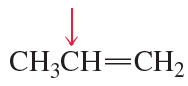
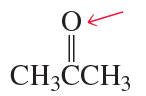
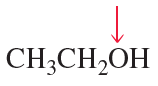
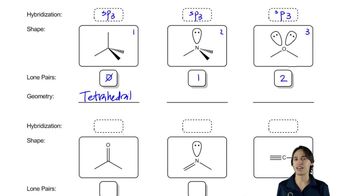
What is the hybridization of the indicated atom in each of the following? a. b. c.
Verified step by step guidance
1
Step 1: Analyze the structure in part A. The indicated atom is part of a triple bond. In a triple bond, the central atom forms one sigma bond and two pi bonds. This requires sp hybridization, as sp orbitals allow for linear geometry and the formation of two pi bonds.
Step 2: Analyze the structure in part B. The indicated atom is an oxygen atom in a carbonyl group (C=O). The oxygen atom forms one sigma bond with carbon and has two lone pairs. This requires sp² hybridization, as sp² orbitals allow for trigonal planar geometry around the carbonyl group.
Step 3: Analyze the structure in part C. The indicated atom is an oxygen atom in an alcohol group (-OH). The oxygen atom forms one sigma bond with carbon and one sigma bond with hydrogen, and it has two lone pairs. This requires sp³ hybridization, as sp³ orbitals allow for tetrahedral geometry around the oxygen atom.
Step 4: Review the hybridization rules: sp hybridization occurs with linear geometry and two regions of electron density, sp² hybridization occurs with trigonal planar geometry and three regions of electron density, and sp³ hybridization occurs with tetrahedral geometry and four regions of electron density.
Step 5: Confirm the hybridization for each indicated atom based on the bonding and lone pairs present in the molecular structures provided in parts A, B, and C.
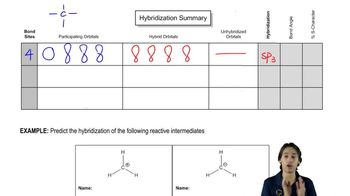
Verified video answer for a similar problem:
This video solution was recommended by our tutors as helpful for the problem above
Video duration:
4m
Play a video:
0 Comments
Key Concepts
Here are the essential concepts you must grasp in order to answer the question correctly.
Hybridization
Hybridization is the concept in organic chemistry that describes the mixing of atomic orbitals to form new hybrid orbitals. These hybrid orbitals are used to form covalent bonds in molecules. The type of hybridization (sp, sp2, sp3) depends on the number of sigma bonds and lone pairs around the central atom, influencing the geometry and reactivity of the molecule.
The geometry of a molecule is determined by the arrangement of its atoms and the type of hybridization of the central atom. For example, sp hybridization leads to a linear geometry with bond angles of 180°, sp2 results in a trigonal planar shape with 120° angles, and sp3 gives a tetrahedral configuration with 109.5° angles. Understanding these geometries is crucial for predicting molecular behavior and reactivity.
Functional groups are specific groups of atoms within molecules that are responsible for the characteristic chemical reactions of those molecules. In the provided structures, the presence of double bonds (alkenes) and functional groups like hydroxyl (-OH) influences the hybridization of the atoms involved. Recognizing these groups helps in determining the hybridization and reactivity of the compounds.