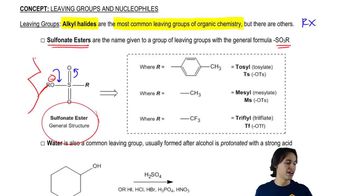
Which member in each pair in [PROBLEM 9-68] is a better leaving group? e. I− or Br− f. Cl− or Br−
Verified step by step guidance
1
Step 1: Understand the concept of leaving groups. A leaving group is an atom or group that detaches from the parent molecule during a chemical reaction, typically in substitution or elimination reactions. The better leaving group is usually the one that can stabilize the negative charge after leaving.
Step 2: Recall the periodic trends in electronegativity and size. Larger atoms tend to stabilize negative charges better due to their ability to spread out the charge over a larger volume. This is important for determining the relative ability of halide ions (I−, Br−, Cl−) to act as leaving groups.
Step 3: Compare the size of the halide ions. Iodide (I−) is larger than bromide (Br−), and bromide (Br−) is larger than chloride (Cl−). The larger the ion, the better it can stabilize the negative charge, making it a better leaving group.
Step 4: Consider the bond strength between the halide and the carbon atom in the molecule. A weaker bond is easier to break, which also contributes to the halide's ability to act as a leaving group. I− forms weaker bonds compared to Br−, and Br− forms weaker bonds compared to Cl−.
Step 5: Based on these factors, evaluate each pair: (e) I− vs. Br− and (f) Cl− vs. Br−. The larger halide ion in each pair will generally be the better leaving group due to its ability to stabilize the negative charge more effectively.
Verified video answer for a similar problem:
This video solution was recommended by our tutors as helpful for the problem above
Video duration:
6m
Play a video:
0 Comments
Key Concepts
Here are the essential concepts you must grasp in order to answer the question correctly.
Leaving Groups
Leaving groups are atoms or groups of atoms that can depart from a molecule during a chemical reaction, typically in nucleophilic substitution or elimination reactions. A good leaving group is one that can stabilize the negative charge after departure, often due to its ability to resonate or its size. Common examples include halides like I−, Br−, and Cl−, with their effectiveness generally increasing down the group in the periodic table.
Nucleophilicity refers to the ability of a species to donate an electron pair to an electrophile, while electronegativity is a measure of an atom's ability to attract electrons. In the context of leaving groups, more electronegative atoms tend to hold onto their electrons more tightly, making them poorer leaving groups. Conversely, larger atoms like iodine are less electronegative and can stabilize the negative charge better, making them better leaving groups.
The stability of a leaving group after it departs is crucial in determining its effectiveness. A stable leaving group can better accommodate the negative charge, which is often the case for larger halides. For instance, I− is more stable than Br− or Cl− due to its larger size and lower electronegativity, making it a better leaving group in reactions compared to the other halides.