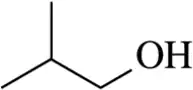
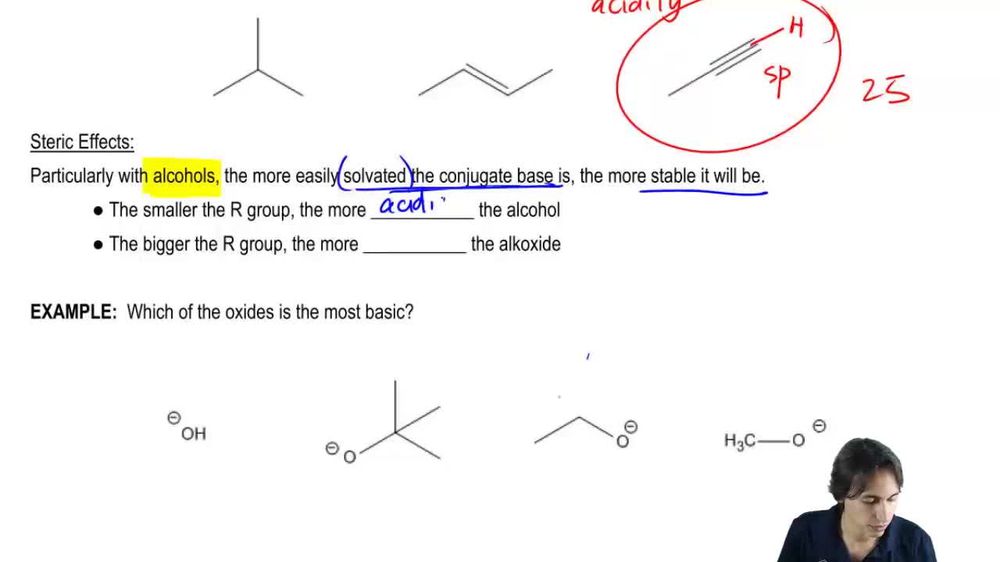
Would you expect the following bases to favor E1 or E2 elimination? (a)
Verified step by step guidance
1
Step 1: Understand the difference between E1 and E2 elimination mechanisms. E1 elimination is a two-step process involving the formation of a carbocation intermediate, while E2 elimination is a one-step process where the base abstracts a proton and the leaving group departs simultaneously.
Step 2: Analyze the strength of the base. Strong bases typically favor E2 elimination because they can efficiently abstract a proton in a single step. Weak bases, on the other hand, are more likely to favor E1 elimination as they do not have the strength to directly abstract a proton.
Step 3: Consider the substrate structure. E1 elimination is favored by substrates that can form stable carbocations (e.g., tertiary carbons or allylic/benzylic carbons). E2 elimination is less dependent on carbocation stability and can occur with primary, secondary, or tertiary substrates.
Step 4: Evaluate steric hindrance. Bulky bases are more likely to favor E2 elimination because steric hindrance makes it difficult for them to approach the substrate closely enough to facilitate carbocation formation, which is required for E1.
Step 5: Examine reaction conditions. E1 elimination is typically favored under conditions that promote carbocation formation, such as polar protic solvents and heat. E2 elimination is favored under conditions that support strong base activity, such as polar aprotic solvents.
Verified video answer for a similar problem:

This video solution was recommended by our tutors as helpful for the problem above
Play a video:
0 Comments
Key Concepts
Here are the essential concepts you must grasp in order to answer the question correctly.
E1 and E2 Mechanisms
E1 (unimolecular elimination) and E2 (bimolecular elimination) are two types of elimination reactions in organic chemistry. E1 involves a two-step mechanism where the leaving group departs first, forming a carbocation, followed by deprotonation to form the alkene. In contrast, E2 is a one-step mechanism where the base abstracts a proton while the leaving group departs simultaneously, leading to the formation of the alkene.
The strength and steric hindrance of the base play a crucial role in determining whether an E1 or E2 mechanism will be favored. Strong bases, such as alkoxides, typically favor E2 reactions due to their ability to abstract protons quickly. Conversely, weak bases or those that are sterically hindered may lead to E1 reactions, as they are less effective at deprotonation and may allow for carbocation formation.
The structure of the substrate, particularly the degree of substitution at the carbon bearing the leaving group, influences the preference for E1 or E2 mechanisms. Tertiary substrates favor E1 due to the stability of the resulting carbocation, while primary substrates are more likely to undergo E2 elimination, as they do not stabilize carbocations effectively. Secondary substrates can lead to both mechanisms depending on the conditions.